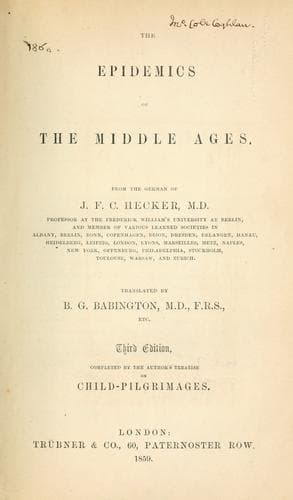
The Epidemics of the Middle AgesHecker, J. F. C. (Justus Friedrich Carl)
History
The Epidemics of the Middle Ages
Hecker, J. F. C. (Justus Friedrich Carl)
Black Death; Epidemics -- History; Hysteria, Epidemic
It is ascertained that the _Sweating Fever was in general very
inflammatory_; and, leaving out of the account its sequel, _came to
a crisis at most in four and twenty hours_; yet, within this narrow
limit as to time, very various symptoms occurred[679], so that by a
more exact observation than could be expected from the physicians of
those days, several gradations of its development and violence might
have been distinguished from each other. Thus one form of this disease
appeared that was wanting in precisely that symptom which was the most
essential, namely, the colliquative sweating[680], (as in the most
dangerous form of cholera, neither vomiting nor purging takes place,)
and which, by its overpowering attack, either destroyed life within a
few hours, or perhaps took some other turn of a nature unknown to us.
Premonitory symptoms were wanting altogether, unless we may reckon as
such, first, an anguish, combined with palpitation of the heart, which
may not have been of corporeal origin, but may have proceeded from
the general alarm; or secondly, an irresistible sinking of the powers
resembling a swoon, which, perhaps, preceded the disorder, in the
same manner as it had preceded the general eruption of the plague in
northern Germany[681]: or thirdly, rheumatic pains of various kinds,
which were frequently felt in the summer of 1529[682]; or finally,
a disagreeable taste in the mouth and foul breath, which were very
commonly the subject of complaint at that time[683].
In most instances the disease set in like the generality of fevers,
with a _short shivering fit_[684] and trembling, which in very
malignant cases even passed into convulsions of the extremities[685];
in many it began with a moderate and constantly increasing heat[686]
either without any evident occasion, even in the midst of sleep, so
that the patients on waking lay in a state of perspiration, or from a
state of intoxication, and during hard work[687], especially in the
morning at sunrise[688]. Many patients experienced at the commencement
a disagreeable _creeping sensation_ or _formication on their hands
and feet_[689], which passed into pricking pains, and an exceedingly
_painful sensation under the nails_. At times likewise it was combined
with rheumatic cramps, and with such a weariness in the upper part of
the body, that the sufferers were totally incapable of raising their
arms[690]. Some were seen during these attacks, especially women and
those who were weak, with their hands and feet swollen[691].
Public-domain text, read in full here on John Shaqi.
Reviews
Reviews
No reviews yet
Be the first to share your thoughts on this work.
Elsewhere in the archive
Join the Discussion
Join the discussion
Sign in to leave a comment or review.
Sign InorCreate an account