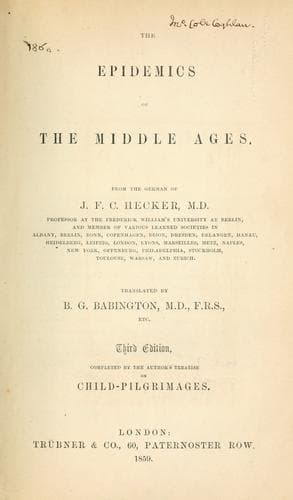
The Epidemics of the Middle AgesHecker, J. F. C. (Justus Friedrich Carl)
History
The Epidemics of the Middle Ages
Hecker, J. F. C. (Justus Friedrich Carl)
Black Death; Epidemics -- History; Hysteria, Epidemic
Serious affections of the brain quickly followed; many fell into a
state of violent feverish delirium[692], and these generally died[693].
All complained of obscure _pain in the head_[694]; and it was not
long before an alarming _lethargy_ supervened[695], which, if it
was not firmly resisted, led to inevitable death by apoplexy. Thus
the unconscious sufferers were, at least, relieved from the pain
of separation from their friends, which would have been much more
distressing to them in this than in any other complaint, since they
lay, as it were, in a stinking swamp, tortured with suffering.
This mortal anguish accompanied them so long as they were in possession
of their senses, throughout the whole disease[696]. _In many the
countenance was bloated and livid_, or at least the lips and cavities
of the eyes were of a leaden tint; whence it evidently appears, that
the passage of the blood through the lungs was obstructed in the
same way as in violent asthma[697]; _hence they breathed with great
difficulty_, as if their lungs were seized with a violent spasm
or incipient paralysis; at the same time, _the heart trembled and
palpitated_ constantly under the oppressive feeling of inward burning,
which, in the most malignant cases, flew to the head, and excited fatal
delirium[698]. In the course of a short time, and in many cases at
the very commencement, the _stinking sweat_ broke out in streams over
the whole body, either proving salutary when life was able to obtain
the mastery over the disease, or prejudicial when it was subdued by
it—as is the case in every ineffectual effort of nature to produce a
cure. And in this respect, as in diseases of less importance, great
differences appeared according to the constitution of the patient;
for some perspired very easily, others, on the contrary, with great
difficulty, especially the phlegmatic, who, in consequence, were
threatened with the greatest danger[699].
In this severe struggle the _spinal marrow_ was sometimes, at a later
stage, so much affected, that even _convulsions_ came on; and it
happened not unfrequently, that, in consequence of the constriction
of the chest, the stomach indicated its excited condition by _nausea_
and _vomiting_[700]. These symptoms, however, manifested themselves
principally in those who were attacked with the disease upon a full
stomach.
Public-domain text, read in full here on John Shaqi.
Reviews
Reviews
No reviews yet
Be the first to share your thoughts on this work.
Elsewhere in the archive
Join the Discussion
Join the discussion
Sign in to leave a comment or review.
Sign InorCreate an account