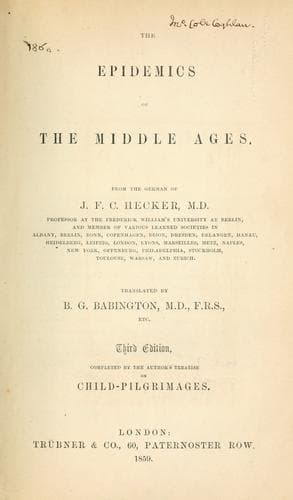
The Epidemics of the Middle AgesHecker, J. F. C. (Justus Friedrich Carl)
History
The Epidemics of the Middle Ages
Hecker, J. F. C. (Justus Friedrich Carl)
Black Death; Epidemics -- History; Hysteria, Epidemic
In the first place, the very great _susceptibility of those affected
with the Sweating Fever to every change of temperature_—the decidedly
great danger of chill. In no known disease does this irritability of
the skin shew itself in so prominent a degree as in rheumatic fevers
and in those non-febrile fluxes in which there even exists a very
evident sensitiveness to _metallic_ action.
Secondly, _The tendency of the rheumatic diathesis to come to a crisis
through the medium of a profuse, sour and offensive perspiration_
without any assistance from art[725]. The English Sweating Sickness
manifests this commotion of the organism in the most exquisite form
hitherto known; for it admits of no kind of doubt that the sweat in
this disease was of itself, and in itself, critical, in the fullest
acceptation of the term.
Thirdly, _The peculiar alteration in the fundamental composition of
organic matter_ in rheumatic diseases, in consequence of which volatile
acids of a strange odour are prevalent in the sweat, and urine, and
animal excretions. The English Sweating Sickness exhibits also this
result of morbid activity in a greater and more striking manner than
any other disease. Nor can we regard the tendency to putridity, which
has been observed, as any thing but an increased degree of this
condition.
Fourthly, _The shooting pains in the limbs_, the most decided sign of
rheumatism, were not wanting in the English Sweating Sickness; nay,
they became developed even to the extent of an incipient paralysis,
and even the convulsions of those affected with this disease may not
unjustly be attributed to the same source.
Fifthly, _The tendency of rheumatism when it takes an unfavourable
course to pass into regular dropsy_, which is a consequence of the
peculiar decomposition, manifested itself in the Sweating Fever in so
marked a manner that the dropsy itself gradually destroyed the patient.
Should the sceptical still need another link in the comparison, we may
adduce the miliary fever, a disease of decidedly rheumatic character.
We must not, however, take as our standard the degenerate forms of
miliary fever existing in modern times, but those grand and fully
developed forms of the disease which occurred in the 17th and 18th
centuries, and in which we find a similar odour in the perspiration,
the same oppression, and the same inexpressible anguish, with
palpitation and restlessness. The arms became enfeebled as if seized
with paralysis, violent pains of the limbs set in, and unpleasant
pricking sensations in the fingers and toes, resembling in all these
particulars the Sweating Sickness, only pursuing a more lengthened and
irregular course, and becoming developed altogether in a different
manner.
Public-domain text, read in full here on John Shaqi.
Reviews
Reviews
No reviews yet
Be the first to share your thoughts on this work.
Elsewhere in the archive
Join the Discussion
Join the discussion
Sign in to leave a comment or review.
Sign InorCreate an account