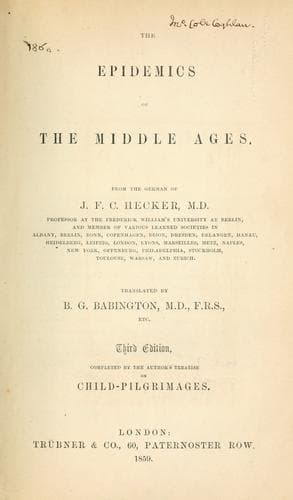
The Epidemics of the Middle AgesHecker, J. F. C. (Justus Friedrich Carl)
History
The Epidemics of the Middle Ages
Hecker, J. F. C. (Justus Friedrich Carl)
Black Death; Epidemics -- History; Hysteria, Epidemic
_According to this representation, the English Sweating Sickness
appears as a rheumatic fever in the most exquisite form_ that has ever
yet been seen in the world, violently affecting the vitality of the
brain and spinal marrow with their nerves, without, however, at all
molesting the plexuses of the abdomen. _The immoderate excretion of
watery fluid_, which in the mild cases alone took place, through a
spontaneous curative power, while in the malignant forms it betokened
paralysis of the vessels and an actual colliquation, directs our
attention further to the _consequent state of inanition_, which very
probably passed into a _stagnation of the circulation_, in the same
manner as takes place after every other sudden loss of the fluids,
whether from sanguineous effusion or evacuations by vomit and stool.
Hence the uncommonly rapid course of the disease, and partly, too, the
fatal stupor[726]; hence, likewise, the very pardonable misconception
with respect to the nature of the Sweating Fever existing even in more
modern times. The sequela was more important and more fatal than the
original rheumatic affection itself, which in its minor forms was mild
and easily managed.
And thus is explained the wonderfully fortunate result of the old
English treatment, which prevented this sequela, and avoided increasing
the already too powerful efforts of nature to effect a cure. We
have, therefore, nothing further to add to this judicious and truly
scientific practice but our unqualified approbation; _for it is the
part of the physician, in diseases which have a spontaneous power of
curing themselves, to leave this power free scope to act, and merely
by fostering care to remove all obstacles to its exercise_. Should it
be the destiny of mankind to be again visited by the disease of the
sixteenth century, (and it is by no means impossible that at some time
or other similar events may recur,) we would recommend our posterity to
bear in mind this eternal truth, and to treasure up the golden words of
the Wittenberg pamphlet, namely, to guard the healing art from strange
and unnatural farragos, _for it is only when it is subordinate to
nature that it bears the stamp of reason—the mistress of all earthly
things_.
CHAPTER V.
FIFTH VISITATION OF THE DISEASE.—1551.
“Ubique lugubris erat lamentatio, fletus mœrens, acerbus luctus.”
KAYE.
SECT. 1.—ERUPTION.
Public-domain text, read in full here on John Shaqi.
Reviews
Reviews
No reviews yet
Be the first to share your thoughts on this work.
Elsewhere in the archive
Join the Discussion
Join the discussion
Sign in to leave a comment or review.
Sign InorCreate an account