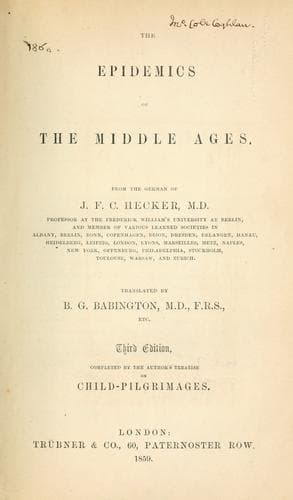
The Epidemics of the Middle AgesHecker, J. F. C. (Justus Friedrich Carl)
History
The Epidemics of the Middle Ages
Hecker, J. F. C. (Justus Friedrich Carl)
Black Death; Epidemics -- History; Hysteria, Epidemic
Full three and twenty years had now elapsed; no trace of the Sweating
Sickness had shewn itself anywhere in this long interval, and England
had by its rapid advancement assumed quite another aspect[727] when
the old enemy of that people again, and for the last time, burst
forth in Shrewsbury, the capital of Shropshire[728]. Here, during the
spring, there arose impenetrable fogs from the banks of the Severn,
which, from their unusually bad odour, led to a fear of their injurious
consequences[729]. It was not long before the Sweating Sickness
suddenly broke out on the 15th of April. To many it was entirely
unknown or but obscurely recollected; for, amidst the commotions of
Henry’s reign, the old malady had long since been forgotten.
The visitation was so very general in Shrewsbury and the places in its
neighbourhood, that every one must have believed that the atmosphere
was poisoned, for no caution availed, no closing of the doors and
windows, every individual dwelling became an hospital, and the aged
and the young, who could contribute nothing towards the care of their
relatives, alone remained unaffected by the pestilence[730]. The
disease came as unexpectedly and as completely without all warning
as it had ever done on former occasions; at table, during sleep, on
journeys, in the midst of amusement, and at all times of the day;
and so little had it lost of its old malignity, that in a few hours
it summoned some of its victims from the ranks of the living, and
even destroyed others in less than one[731]. _Four and twenty hours_,
neither more nor less, _were decisive as to the event_; the disease had
thus undergone no change.
In proportion as the pestilence increased in its baneful violence, the
condition of the people became more and more miserable and forlorn; the
townspeople fled to the country, the peasants to the towns; some sought
lonely places of refuge, others shut themselves up in their houses.
Ireland and Scotland received crowds of the fugitives. Others embarked
for France or the Netherlands; but security was nowhere to be found; so
that people at last resigned themselves to that fate which had so long
and heavily oppressed the country. Women ran about negligently clad, as
if they had lost their senses, and filled the streets with lamentations
and loud prayers; all business was at a stand; no one thought of his
daily occupations, and the funeral bells tolled day and night, as
if all the living ought to be reminded of their near and inevitable
end[732]. There died, within a few days, nine hundred and sixty of the
inhabitants of Shrewsbury, the greater part of them robust men and
heads of families; from which circumstance we may judge of the profound
sorrow that was felt in this city.
SECT. 2.—EXTENSION AND DURATION.
Public-domain text, read in full here on John Shaqi.
Reviews
Reviews
No reviews yet
Be the first to share your thoughts on this work.
Elsewhere in the archive
Join the Discussion
Join the discussion
Sign in to leave a comment or review.
Sign InorCreate an account