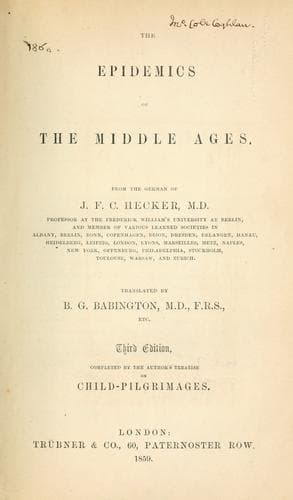
The Epidemics of the Middle AgesHecker, J. F. C. (Justus Friedrich Carl)
History
The Epidemics of the Middle Ages
Hecker, J. F. C. (Justus Friedrich Carl)
Black Death; Epidemics -- History; Hysteria, Epidemic
It has, no doubt, struck the reader that each of the five eruptions
in England lasted much longer than the single one which occurred
in Germany and the north of Europe. This, too, might well depend
upon peculiarities in the English soil. But let us now endeavour
to render manifest, by means of phenomena actually observed, that
unknown something in the atmosphere of 1551, the θεῖον of the great
Hippocrates, which announces its presence by the sickening of the
people; for beyond this it is not granted that human researches should
penetrate. The winter of 1550–51 was dry and warm in England; the
spring dry and cold; the summer and autumn hot and moist[748]. The
weather of the whole year was uncommon in many particulars, without,
however, influencing the lives of plants and animals so much or
through so great a range as at the time of the fourth epidemic of
Sweating Sickness. It was even in some places praised as fruitful[749].
On the 10th of January a violent tempest occurred, which in Germany
left no small traces[750] of its effects on houses and towers. The
same day brought considerable floods in the river district of the
Lahn, which must be noticed on account of the very unusual season of
the year[751]. On the 13th of January, again at an unusual season,
there followed a great storm with heavy rains[752], which spread over
the north of Germany; and on the 28th of January there occurred a
considerable earthquake in Lisbon, whereby about two hundred houses
were overthrown, and nearly a thousand people were destroyed; whilst
a fiery meteor appeared, which, according to the unsatisfactory
descriptions of the time, resembled most a northern light, and
therefore was, in all probability, of electrical origin[753]. This
was succeeded in Germany by a great frost in February[754]. On the
21st of March, at seven o’clock in the morning, two mock suns, with
three rainbows, were seen at Magdeburg and in its vicinity, and in the
evening two mock moons[755]. The same mock suns were also observed at
Wittenberg, but without the rainbows. A similar phenomenon with two
rainbows was again seen on the 27th of March[756]; and mock suns had
been observed at Antwerp as early as the 28th of February[757]. About
the same time (21st of March) the Oder overflowed its banks[758],
and floods followed after continued rains during the month of May in
Thuringia and Franconia[759]. Great tempests were not wanting[760],
and, after considerable heat, there occurred, on the 26th of June,
a thick summer fog in the districts of the Elbe which deprived the
besiegers of Magdeburg of the sight of that city. It may, therefore, be
supposed that this phenomenon took place throughout a greater extent
of country[761]. On the 22nd of September a meteor, like a northern
light, was again seen, and on the 29th of that month, after some clear
weather, a heavy fall of snow was followed by continued cold[762].
Public-domain text, read in full here on John Shaqi.
Reviews
Reviews
No reviews yet
Be the first to share your thoughts on this work.
Elsewhere in the archive
Join the Discussion
Join the discussion
Sign in to leave a comment or review.
Sign InorCreate an account