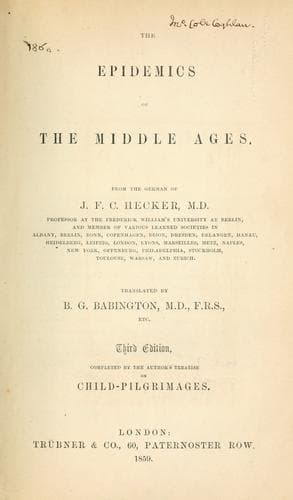
The Epidemics of the Middle AgesHecker, J. F. C. (Justus Friedrich Carl)
History
The Epidemics of the Middle Ages
Hecker, J. F. C. (Justus Friedrich Carl)
Black Death; Epidemics -- History; Hysteria, Epidemic
These facts are sufficient plainly to prove that the course of the
year 1551 was unusual, that the atmosphere was overcharged with water,
and that the electrical conditions of it were considerably disturbed;
nor must we omit to notice that, for the first time since 1547, mould
spots again appeared in Germany on clothes, and red discolorations of
water, as likewise an exuberance of the lowest cryptogamic species of
vegetation[763].
SECT. 4.—DISEASES.
During the years of scarcity, from 1528 to 1534, it excited general
surprise that malignant fevers, more especially the plague, petechial
fever, and encephalitis, which in the individual accounts we can seldom
sufficiently distinguish from each other, were constantly recurring,
and, creeping slowly as they did from place to place, had no sooner
finished their wandering visitations of whole districts of country,
than they again made their appearance where they had broken out in
former years[764]. It was _a century of putrid malignant affections_,
in which typhous diseases were continually prevailing—a century replete
with grand phenomena affecting human life in general, and continuing
so, long after the period to which our researches refer.
There existed also an epidemic flux which, during a cold summer[765]
in 1538, spread over a great part of Europe, and especially over
France, so that, according to the assurance of an eminent physician,
there was scarcely any town exempt from it[766]. Of this flux we have
unfortunately but very defective reports, among which we find a
statement, not without importance, that there were no extraordinary
forerunners, such as are observed in phenomena of this kind, to
account for this epidemic[767]. Two years earlier, however, (12th of
July 1536,) Erasmus died of the flux[768]. This disease seldom occurs
sporadically, but usually as an epidemic, and thus, perhaps slighter
visitations of this rheumatic malady may be assumed to have preceded
that greater one which took place in 1538.
Public-domain text, read in full here on John Shaqi.
Reviews
Reviews
No reviews yet
Be the first to share your thoughts on this work.
Elsewhere in the archive
Join the Discussion
Join the discussion
Sign in to leave a comment or review.
Sign InorCreate an account