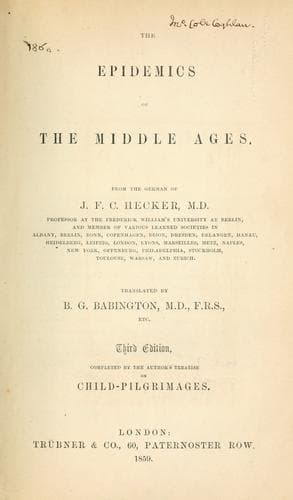
The Epidemics of the Middle AgesHecker, J. F. C. (Justus Friedrich Carl)
History
The Epidemics of the Middle Ages
Hecker, J. F. C. (Justus Friedrich Carl)
Black Death; Epidemics -- History; Hysteria, Epidemic
This phenomenon is one of the rarest that has ever been observed, for
nothing is more constant than the composition of the air; and in no
respect has nature been more careful in the preservation of organic
life. Never have naturalists discovered in the atmosphere foreign
elements, which, evident to the senses, and borne by the winds, spread
from land to land, carrying disease over whole portions of the earth,
as is recounted to have taken place in the year 1348. It is, therefore,
the more to be regretted, that in this extraordinary period, which,
owing to the low condition of science, was very deficient in accurate
observers, so little that can be depended on respecting those uncommon
occurrences in the air, should have been recorded. Yet, German accounts
say expressly, that a thick, stinking mist advanced from the East, and
spread itself over Italy[37]; and there could be no deception in so
palpable a phenomenon[38]. The credibility of unadorned traditions,
however little they may satisfy physical research, can scarcely be
called in question when we consider the connexion of events; for just
at this time earthquakes were more general than they had been within
the range of history. In thousands of places chasms were formed, from
whence arose noxious vapours; and as at that time natural occurrences
were transformed into miracles, it was reported, that a fiery meteor,
which descended on the earth far in the East, had destroyed every
thing within a circumference of more than a hundred leagues, infecting
the air far and wide[39]. The consequences of innumerable floods
contributed to the same effect; vast river districts had been converted
into swamps; foul vapours arose everywhere, increased by the odour of
putrified locusts, which had never perhaps darkened the sun in thicker
swarms[40], and of countless corpses, which, even in the well regulated
countries of Europe, they knew not how to remove quickly enough out of
the sight of the living. It is probable, therefore, that the atmosphere
contained foreign, and sensibly perceptible, admixtures to a great
extent, which, at least in the lower regions, could not be decomposed,
or rendered ineffective by separation.
Now, if we go back to the symptoms of the disease, the ardent
inflammation of the lungs points out, that the organs of respiration
yielded to the attack of an atmospheric poison—a poison, which, if we
admit the independent origin of the Black Plague at any one place on
the globe, which, under such extraordinary circumstances, it would
be difficult to doubt, attacked the course of the circulation in as
hostile a manner as that which produces inflammation of the spleen, and
other animal contagions that cause swelling and inflammation of the
lymphatic glands.
Public-domain text, read in full here on John Shaqi.
Reviews
Reviews
No reviews yet
Be the first to share your thoughts on this work.
Join the Discussion
Join the discussion
Sign in to leave a comment or review.
Sign InorCreate an account