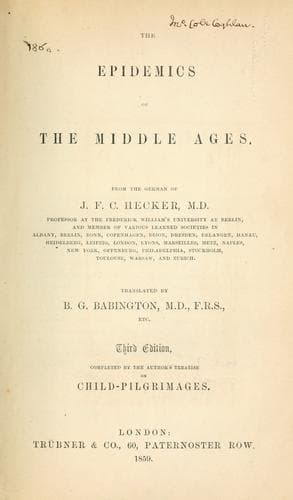
The Epidemics of the Middle AgesHecker, J. F. C. (Justus Friedrich Carl)
History
The Epidemics of the Middle Ages
Hecker, J. F. C. (Justus Friedrich Carl)
Black Death; Epidemics -- History; Hysteria, Epidemic
Pursuing the course of these grand revolutions further, we find notice
of an unexampled earthquake, which, on the 25th of January, 1348, shook
Greece, Italy, and the neighbouring countries. Naples, Rome, Pisa,
Bologna, Padua, Venice and many other cities suffered considerably:
whole villages were swallowed up. Castles, houses and churches were
overthrown, and hundreds of people were buried beneath their ruins[41].
In Carinthia, thirty villages, together with all the churches, were
demolished; more than a thousand corpses were drawn out of the rubbish;
the city of Villach was so completely destroyed, that very few of
its inhabitants were saved; and when the earth ceased to tremble, it
was found that mountains had been moved from their positions, and
that many hamlets were left in ruins[42]. It is recorded that, during
this earthquake, the wine in the casks became turbid, a statement
which may be considered as furnishing a proof, that changes causing a
decomposition of the atmosphere had taken place; but if we had no other
information from which the excitement of conflicting powers of nature
during these commotions might be inferred, yet scientific observations
in modern times have shewn, that the relation of the atmosphere to the
earth is changed by volcanic influences. Why then, may we not, from
this fact, draw retrospective inferences respecting those extraordinary
phenomena?
Independently of this, however, we know that during this earthquake,
the duration of which is stated by some to have been a week, and by
others a fortnight, people experienced an unusual stupor and headache,
and that many fainted away[43].
These destructive earthquakes extended as far as the neighbourhood
of Basle[44], and recurred until the year 1360, throughout Germany,
France, Silesia, Poland, England and Denmark, and much further
north[45].
Great and extraordinary meteors appeared in many places, and were
regarded with superstitious horror. A pillar of fire, which on the 20th
of December, 1348, remained for an hour at sunrise over the pope’s
palace in Avignon[46]; a fireball, which in August of the same year
was seen at sunset over Paris, and was distinguished from similar
phenomena, by its longer duration[47], not to mention other instances
mixed up with wonderful prophecies and omens, are recorded in the
chronicles of that age.
Public-domain text, read in full here on John Shaqi.
Reviews
Reviews
No reviews yet
Be the first to share your thoughts on this work.
Join the Discussion
Join the discussion
Sign in to leave a comment or review.
Sign InorCreate an account