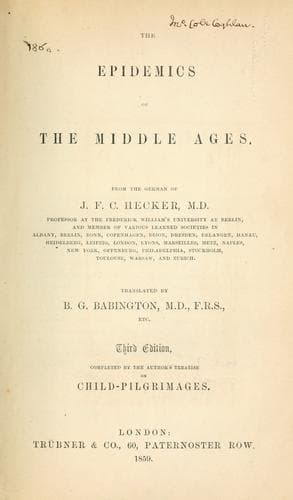
The Epidemics of the Middle AgesHecker, J. F. C. (Justus Friedrich Carl)
History
The Epidemics of the Middle Ages
Hecker, J. F. C. (Justus Friedrich Carl)
Black Death; Epidemics -- History; Hysteria, Epidemic
A period remarkable for plague followed in the year 1540, and ended
about 1543. The summer of the first named year is especially mentioned
in the chronicles as having been _hot_, and throughout the whole
century it continued to be in great repute on account of the excellent
wine it produced[769]. A spontaneous conflagration of the woods
was frequent, and an earthquake was felt in Germany on the 14th of
December[770]. Thereupon, in 1541, there followed in Constantinople
a great plague[771] which, in the year 1542, spread by means of a
Turkish invasion into Hungary, its superior importance being indicated
by the presence of accompanying phenomena, among which the swarms of
locusts that appeared this year are especially worthy of note. They
came from the interior of Asia, and travelled in dense masses over
Europe, passing northward over the Elbe[772], and southward as far as
Spain[773]. Kaye saw a cloud of locusts of this description in Padua;
their passage lasted full two hours, and they extended further than the
eye could reach[774]. The plague quickly spread in Hungary and caused
a similar destruction to the imperial army, which was fighting against
the Turks under Joachim the Second, Elector of Brandenburg, as it had
formerly caused the French before Naples[775]. Whether this pestilence
may have been the original oriental glandular plague, or whether we may
assume that it had already degenerated into the _Hungarian Petechial
Fever_, such as likewise broke out in the year 1566, in the camp near
Komorn, during the campaign of Maximilian the Second, and thence, by
means of the disbanded lansquenets, spread in all directions[776],
cannot now well be determined for want of ascertained facts. In the
following year, 1543, however, this plague broke out in Germany,
namely, in the Harz districts in the provinces of the Saale[777], and
still more malignantly at Metz[778], yet upon the whole it did not
cause any considerable loss of life.
In the years 1545 and 1546 we again find the _Trousse-galant_ in
France[779]. It proved fatal to the Duke of Orleans, second son of
Francis the First, in the neighbourhood of Boulogne, and, according to
the testimony of French historians, to ten thousand English in that
fort, so that the garrison was obliged to pitch a camp outside the
town, and the reluctant reinforcements felt that they were encountering
certain death[780]. The disease spread itself also among the French
troops, and we have seen that it extended its dominion beyond the Alps
of Savoy[781].
Public-domain text, read in full here on John Shaqi.
Reviews
Reviews
No reviews yet
Be the first to share your thoughts on this work.
Elsewhere in the archive
Join the Discussion
Join the discussion
Sign in to leave a comment or review.
Sign InorCreate an account