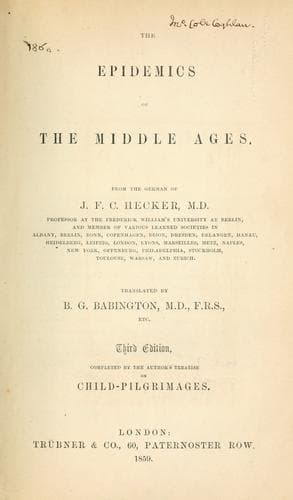
The Epidemics of the Middle AgesHecker, J. F. C. (Justus Friedrich Carl)
History
The Epidemics of the Middle Ages
Hecker, J. F. C. (Justus Friedrich Carl)
Black Death; Epidemics -- History; Hysteria, Epidemic
It thus appears, that, up to the period of which we have been speaking,
the year 1544 alone was free from great visitations of disease, but
it would be difficult from thenceforth satisfactorily to define the
individual groups of epidemics, if the connexion of the epidemic
Sweating Sickness of the year 1551 with them is to be made out; for
there was, to use an expression of the schools, a continued _typhous
constitution_, which extended throughout this whole period, manifesting
itself on the slightest causes by malignant diseases; so that the
visitations of sickness which we have hitherto been describing do but
appear as exacerbations of them, with a predominance sometimes of one
and sometimes of another set of symptoms.
The camp fever, which prevailed in the spring of 1547 among the
imperial troops, there is good ground for considering to have been
petechial. A great many soldiers fell sick of it, and it was so much
the more malignant because the imperial army was composed of a variety
of soldiery, Spaniards, Germans, Hungarians, and Bohemians. Those who
were seized complained, as in encephalitis, of insufferable heat of
the head, their eyes were swollen and started glistening from their
sockets, their offensive breath poisoned the atmosphere around them,
their tongues were covered with a brown crust, they vomited bile, their
skin was of a leaden hue, and a deep purple eruption broke forth upon
it. The disease, the fresh seeds of which the imperial hussars had
brought with them out of Hungary, proved fatal as early as the second
or third day, and it may be taken for granted, that both before and
after the battle of Muhlberg (24th of April) it made no small ravages
in Saxony[782]; yet it did not become general.
After a short interval the unusual phenomena of 1549 again increased;
the chronicles of central Germany record blights and murrains in that
year. They speak likewise of a northern light seen on the 21st of
September, and of a malignant disease which, till the winter set in,
carried off young people in no small numbers[783]. According to all
appearance this disease was a petechial fever, which in the following
year, 1550, likewise visited the March of Brandenburg, Thuringia and
Saxony[784]. The mortality was particularly great at Eisleben, where,
in less than four weeks from the 14th September, 257 fell a sacrifice
to it, and after this period it happened often that from twenty to
twenty-four bodies were buried in one day; so that the loss in this
little town may be reckoned at least at 500[785]. From this slight
example the great malignity of the plagues of the sixteenth century
will be perceived, and it would be still more evident if the physicians
of those times had made more careful observations, and historians had
more accurately recorded facts of this kind.
Public-domain text, read in full here on John Shaqi.
Reviews
Reviews
No reviews yet
Be the first to share your thoughts on this work.
Elsewhere in the archive
Join the Discussion
Join the discussion
Sign in to leave a comment or review.
Sign InorCreate an account