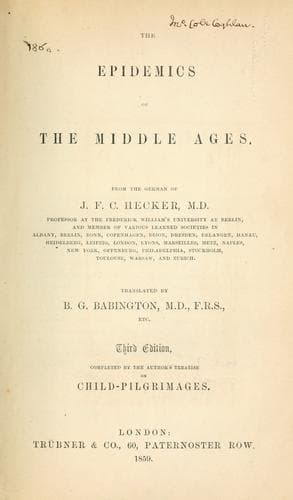
The Epidemics of the Middle AgesHecker, J. F. C. (Justus Friedrich Carl)
History
The Epidemics of the Middle Ages
Hecker, J. F. C. (Justus Friedrich Carl)
Black Death; Epidemics -- History; Hysteria, Epidemic
In the progress of connected natural phenomena, from East to West,
that great law of nature is plainly revealed which has so often and
evidently manifested itself in the earth’s organism, as well as in
the state of nations dependent upon it. In the inmost depths of the
globe, that impulse was given in the year 1333, which in uninterrupted
succession for six-and-twenty years shook the surface of the earth,
even to the western shores of Europe. From the very beginning the
air partook of the terrestrial concussion, atmospherical waters
overflowed the land, or its plants and animals perished under the
scorching heat. The insect tribe was wonderfully called into life, as
if animated beings were destined to complete the destruction which
astral and telluric powers had begun. Thus did this dreadful work of
nature advance from year to year; it was a progressive infection of the
Zones, which exerted a powerful influence both above and beneath the
surface of the earth; and after having been perceptible in slighter
indications, at the commencement of the terrestrial commotions in
China, convulsed the whole earth.
The nature of the first plague in China is unknown. We have no certain
intelligence of the disease, until it entered the western countries of
Asia. Here it shewed itself as the oriental plague with inflammation
of the lungs; in which form it probably also may have begun in China,
that is to say, as a malady which spreads, more than any other,
by contagion—a contagion, that, in ordinary pestilences, requires
immediate contact, and only under unfavourable circumstances of rare
occurrence is communicated by the mere approach to the sick. The share
which this cause had in the spreading of the plague over the whole
earth, was certainly very great: and the opinion that the Black Death
might have been excluded from Western Europe, by good regulations,
similar to those which are now in use, would have all the support of
modern experience, provided it could be proved that this plague had
been actually imported from the East; or that the oriental plague in
general, whenever it appears in Europe, has its origin in Asia or
Egypt. Such a proof, however, can by no means be produced so as to
enforce conviction; for it would involve the impossible assumption,
either that there is no essential difference between the degree of
civilization of the European nations, in the most ancient and in modern
times, or that detrimental circumstances, which have yielded only to
the civilization of human society and the regular cultivation of
countries, could not formerly keep up the glandular plague.
Public-domain text, read in full here on John Shaqi.
Reviews
Reviews
No reviews yet
Be the first to share your thoughts on this work.
Join the Discussion
Join the discussion
Sign in to leave a comment or review.
Sign InorCreate an account