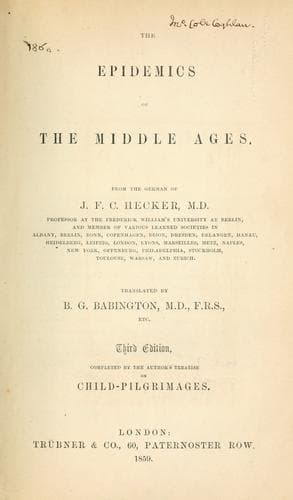
The Epidemics of the Middle AgesHecker, J. F. C. (Justus Friedrich Carl)
History
The Epidemics of the Middle Ages
Hecker, J. F. C. (Justus Friedrich Carl)
Black Death; Epidemics -- History; Hysteria, Epidemic
The order of the seasons seemed to be inverted,—rains, floods and
failures in crops were so general, that few places were exempt from
them; and though an historian of this century assures us, that there
was an abundance in the granaries and storehouses[48], all his
contemporaries, with one voice, contradict him. The consequences of
failure in the crops were soon felt, especially in Italy and the
surrounding countries, where, in this year, a rain which continued for
four months, had destroyed the seed. In the larger cities, they were
compelled, in the spring of 1347, to have recourse to a distribution
of bread among the poor, particularly at Florence, where they erected
large bake-houses, from which, in April, ninety-four thousand loaves of
bread, each of twelve ounces in weight, were daily dispensed[49]. It is
plain, however, that humanity could only partially mitigate the general
distress, not altogether obviate it.
Diseases, the invariable consequence of famine, broke out in the
country, as well as in cities; children died of hunger in their
mothers’ arms,—want, misery and despair, were general throughout
Christendom[50].
Such are the events which took place before the eruption of the
Black Plague in Europe. Contemporaries have explained them after
their own manner, and have thus, like their posterity, under similar
circumstances, given a proof, that mortals possess neither senses nor
intellectual powers sufficiently acute to comprehend the phenomena
produced by the earth’s organism, much less scientifically to
understand their effects. Superstition, selfishness in a thousand
forms, the presumption of the schools, laid hold of unconnected facts.
They vainly thought to comprehend the whole in the individual, and
perceived not the universal spirit which, in intimate union with the
mighty powers of nature, animates the movements of all existence,
and permits not any phenomenon to originate from isolated causes. To
attempt, five centuries after that age of desolation, to point out the
causes of a cosmical commotion, which has never recurred to an equal
extent,—to indicate scientifically the influences which called forth so
terrific a poison in the bodies of men and animals, exceeds the limits
of human understanding. If we are even now unable, with all the varied
resources of an extended knowledge of nature, to define that condition
of the atmosphere by which pestilences are generated, still less can we
pretend to reason retrospectively from the nineteenth to the fourteenth
century; but if we take a general view of the occurrences, that century
will give us copious information, and, as applicable to all succeeding
times, of high importance.
Public-domain text, read in full here on John Shaqi.
Reviews
Reviews
No reviews yet
Be the first to share your thoughts on this work.
Join the Discussion
Join the discussion
Sign in to leave a comment or review.
Sign InorCreate an account