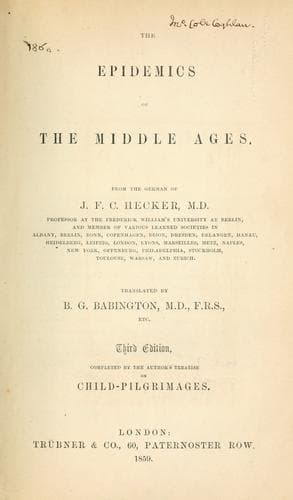
The Epidemics of the Middle AgesHecker, J. F. C. (Justus Friedrich Carl)
History
The Epidemics of the Middle Ages
Hecker, J. F. C. (Justus Friedrich Carl)
Black Death; Epidemics -- History; Hysteria, Epidemic
The precise days of its eruption in the individual towns, are no longer
to be ascertained; but it was not simultaneous; for in Florence, the
disease appeared in the beginning of April[56]; in Cesena, the 1st
of June[57]; and place after place was attacked throughout the whole
year; so that the plague, after it had passed through the whole of
France and Germany, where, however, it did not make its ravages until
the following year, did not break out till August, in England; where
it advanced so gradually, that a period of three months elapsed before
it reached London[58]. The northern kingdoms were attacked by it in
1349. Sweden, indeed, not until November of that year: almost two years
after its eruption in Avignon[59]. Poland received the plague in 1349,
probably from Germany[60], if not from the northern countries; but in
Russia, it did not make its appearance until 1351, more than three
years after it had broken out in Constantinople. Instead of advancing
in a north-westerly direction from Tauris and from the Caspian Sea,
it had thus made the great circuit of the Black Sea, by way of
Constantinople, Southern and Central Europe, England, the northern
kingdoms and Poland, before it reached the Russian territories; a
phenomenon which has not again occurred with respect to more recent
pestilences originating in Asia.
Whether any difference existed between the indigenous plague, excited
by the influence of the atmosphere, and that which was imported
by contagion, can no longer be ascertained from facts; for the
contemporaries, who in general were not competent to make accurate
researches of this kind, have left no data on the subject. A milder
and a more malignant form certainly existed, and the former was
not always derived from the latter, as is to be supposed from this
circumstance—that the spitting of blood, the infallible diagnostic of
the latter, on the first breaking out of the plague, is not similarly
mentioned in all the reports; and it is therefore probable, that the
milder form belonged to the native plague,—the more malignant, to that
introduced by contagion. Contagion was, however, in itself, only one of
many causes which gave rise to the Black Plague.
This disease was a consequence of violent commotions in the earth’s
organism—if any disease of cosmical origin can be so considered. One
spring set a thousand others in motion for the annihilation of living
beings, transient or permanent, of mediate or immediate effect. The
most powerful of all was contagion; for in the most distant countries
which had scarcely yet heard the echo of the first concussion, the
people fell a sacrifice to organic poison,—the untimely offspring of
vital energies thrown into violent commotion.
CHAPTER IV.
MORTALITY.
Public-domain text, read in full here on John Shaqi.
Reviews
Reviews
No reviews yet
Be the first to share your thoughts on this work.
Join the Discussion
Join the discussion
Sign in to leave a comment or review.
Sign InorCreate an account