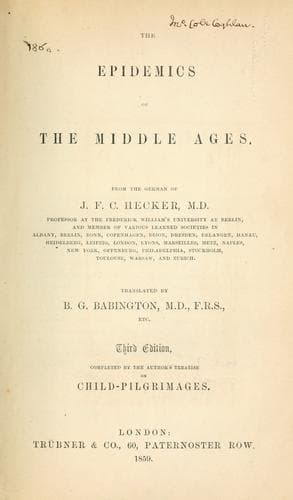
The Epidemics of the Middle AgesHecker, J. F. C. (Justus Friedrich Carl)
History
The Epidemics of the Middle Ages
Hecker, J. F. C. (Justus Friedrich Carl)
Black Death; Epidemics -- History; Hysteria, Epidemic
We have no certain measure by which to estimate the ravages of the
Black Plague, if numerical statements were wanted, as in modern times.
Let us go back for a moment to the 14th century. The people were yet
but little civilized. The church had indeed subdued them; but they
all suffered from the ill consequences of their original rudeness. The
dominion of the law was not yet confirmed. Sovereigns had everywhere
to combat powerful enemies to internal tranquillity and security.
The cities were fortresses for their own defence. Marauders encamped
on the roads.—The husbandman was a feodal slave, without possessions
of his own.—Rudeness was general.—Humanity, as yet unknown to the
people.—Witches and heretics were burned alive.—Gentle rulers were
contemned as weak;—wild passions, severity and cruelty, everywhere
predominated.—Human life was little regarded.—Governments concerned
not themselves about the numbers of their subjects, for whose welfare
it was incumbent on them to provide. Thus, the first requisite for
estimating the loss of human life, namely, a knowledge of the amount of
the population, is altogether wanting; and, moreover, the traditional
statements of the amount of this loss, are so vague, that from this
source likewise, there is only room for probable conjecture.
Kairo lost daily, when the plague was raging with its greatest
violence, from 10 to 15,000; being as many as, in modern times,
great plagues have carried off during their whole course. In China,
more than thirteen millions are said to have died; and this is in
correspondence with the certainly exaggerated accounts from the rest of
Asia. India was depopulated. Tartary, the Tartar kingdom of Kaptschak,
Mesopotamia, Syria, Armenia, were covered with dead bodies—the Kurds
fled in vain to the mountains. In Caramania and Cæsarea, none were
left alive. On the roads,—in the camps,—in the caravansaries,—unburied
bodies alone were seen; and a few cities only (Arabian historians name
Maara el nooman, Schisur and Harem) remained, in an unaccountable
manner, free. In Aleppo, 500 died daily; 22,000 people, and most of
the animals, were carried off in Gaza, within six weeks. Cyprus lost
almost all its inhabitants[61]; and ships without crews were often
seen in the Mediterranean; as afterwards in the North Sea, driving
about, and spreading the plague wherever they went on shore[62]. It
was reported to Pope Clement, at Avignon, that throughout the East,
probably with the exception of China, 23,840,000 people had fallen
victims to the plague[63]. Considering the occurrences of the 14th
and 15th centuries, we might, on first view, suspect the accuracy of
this statement. How (it might be asked) could such great wars have been
carried on—such powerful efforts have been made; how could the Greek
empire, only a hundred years later, have been overthrown, if the people
really had been so utterly destroyed?
Public-domain text, read in full here on John Shaqi.
Reviews
Reviews
No reviews yet
Be the first to share your thoughts on this work.
Join the Discussion
Join the discussion
Sign in to leave a comment or review.
Sign InorCreate an account