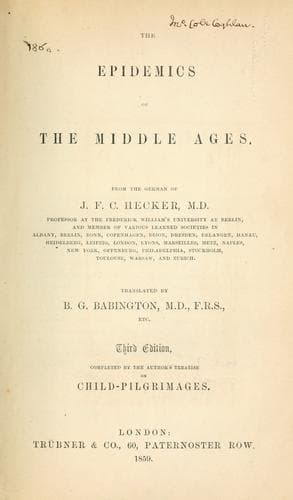
The Epidemics of the Middle AgesHecker, J. F. C. (Justus Friedrich Carl)
History
The Epidemics of the Middle Ages
Hecker, J. F. C. (Justus Friedrich Carl)
Black Death; Epidemics -- History; Hysteria, Epidemic
At the commencement, there was in England a superabundance of all the
necessaries of life; but the plague, which seemed then to be the sole
disease, was soon accompanied by a fatal murrain among the cattle.
Wandering about without herdsmen, they fell by thousands; and, as
has likewise been observed in Africa, the birds and beasts of prey
are said not to have touched them. Of what nature this murrain may
have been, can no more be determined, than whether it originated from
communication with plague patients, or from other causes; but thus much
is certain, that it did not break out until after the commencement of
the Black Death. In consequence of this murrain, and the impossibility
of removing the corn from the fields, there was everywhere a great
rise in the price of food which to many was inexplicable, because the
harvest had been plentiful; by others it was attributed to the wicked
designs of the labourers and dealers; but it really had its foundation
in the actual deficiency arising from circumstances by which individual
classes at all times endeavour to profit. For a whole year, until
it terminated in August, 1349, the Black Plague prevailed in this
beautiful island, and everywhere poisoned the springs of comfort and
prosperity[98].
In other countries, it generally lasted only half a year, but returned
frequently in individual places; on which account, some, without
sufficient proof, assigned to it a period of seven years[99].
Spain was uninterruptedly ravaged by the Black Plague till after the
year 1350, to which the frequent internal feuds and the wars with the
Moors not a little contributed. Alphonso XI., whose passion for war
carried him too far, died of it at the siege of Gibraltar, on the 26th
of March, 1350. He was the only king in Europe who fell a sacrifice to
it; but even before this period, innumerable families had been thrown
into affliction[100]. The mortality seems otherwise to have been
smaller in Spain than in Italy, and about as considerable as in France.
The whole period during which the Black Plague raged with destructive
violence in Europe, was, with the exception of Russia, from the year
1347 to 1350. The plagues, which in the sequel often returned until
the year 1383[101], we do not consider as belonging to “the Great
Mortality.” They were rather common pestilences, without inflammation
of the lungs, such as in former times, and in the following centuries,
were excited by the matter of contagion everywhere existing, and which,
on every favourable occasion, gained ground anew, as is usually the
case with this frightful disease.
The concourse of large bodies of people was especially dangerous; and
thus, the premature celebration of the Jubilee, to which Clement VI.
cited the faithful to Rome, (1350,) during the great epidemic, caused a
new eruption of the plague, from which it is said, that scarcely one in
an hundred of the pilgrims escaped[102].
Public-domain text, read in full here on John Shaqi.
Reviews
Reviews
No reviews yet
Be the first to share your thoughts on this work.
Join the Discussion
Join the discussion
Sign in to leave a comment or review.
Sign InorCreate an account