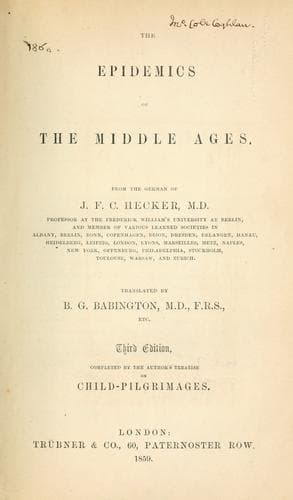
The Epidemics of the Middle AgesHecker, J. F. C. (Justus Friedrich Carl)
History
The Epidemics of the Middle Ages
Hecker, J. F. C. (Justus Friedrich Carl)
Black Death; Epidemics -- History; Hysteria, Epidemic
Italy was, in consequence, depopulated anew; and those who returned,
spread poison and corruption of morals in all directions[103]. It is,
therefore, the less apparent, how that Pope, who was in general so wise
and considerate, and who knew how to pursue the path of reason and
humanity, under the most difficult circumstances, should have been led
to adopt a measure so injurious; since he, himself, was so convinced of
the salutary effect of seclusion, that during the plague in Avignon, he
kept up constant fires, and suffered no one to approach him[104]; and,
in other respects, gave such orders as averted, or alleviated, much
misery.
The changes which occurred about this period in the north of Europe,
are sufficiently memorable to claim a few moments’ attention. In Sweden
two princes died—Håken and Knut, half-brothers of King Magnus; and in
Westgothland alone, 466 priests[105]. The inhabitants of Iceland and
Greenland, found in the coldness of their inhospitable climate, no
protection against the southern enemy who had penetrated to them from
happier countries. The plague caused great havoc among them. Nature
made no allowance for their constant warfare with the elements, and
the parsimony with which she had meted out to them the enjoyments of
life[106]. In Denmark and Norway, however, people were so occupied
with their own misery, that the accustomed voyages to Greenland
ceased. Towering icebergs formed at the same time on the coast of East
Greenland, in consequence of the general concussion of the earth’s
organism; and no mortal, from that time forward, has ever seen that
shore or its inhabitants[107].
It has been observed above, that in Russia, the Black Plague did
not break out until 1351, after it had already passed through the
south and north of Europe. In this country also, the mortality was
extraordinarily great; and the same scenes of affliction and despair
were exhibited, as had occurred in those nations which had already
passed the ordeal. The same mode of burial—the same horrible certainty
of death—the same torpor and depression of spirits. The wealthy
abandoned their treasures, and gave their villages and estates to
the churches and monasteries; this being, according to the notions
of the age, the surest way of securing the favour of Heaven and the
forgiveness of past sins. In Russia too, the voice of nature was
silenced by fear and horror. In the hour of danger, fathers and mothers
deserted their children, and children their parents[108].
Of all the estimates of the number of lives lost in Europe, the most
probable is, that altogether, a fourth part of the inhabitants were
carried off. Now, if Europe at present contain 210,000,000 inhabitants,
the population, not to take a higher estimate, which might easily be
justified, amounted to at least 105,000,000 in the 16th century.
It may, therefore, be assumed, without exaggeration, that Europe lost
during the Black Death, 25,000,000 of inhabitants.
Public-domain text, read in full here on John Shaqi.
Reviews
Reviews
No reviews yet
Be the first to share your thoughts on this work.
Join the Discussion
Join the discussion
Sign in to leave a comment or review.
Sign InorCreate an account