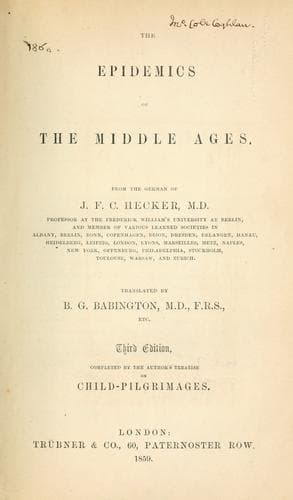
The Epidemics of the Middle AgesHecker, J. F. C. (Justus Friedrich Carl)
History
The Epidemics of the Middle Ages
Hecker, J. F. C. (Justus Friedrich Carl)
Black Death; Epidemics -- History; Hysteria, Epidemic
If we examine the grounds of this oft-repeated assertion, we shall
find that they were astonished to see children cut twenty, or at most,
twenty-two teeth, under the supposition that a greater number had
formerly fallen to their share[109]. Some writers of authority, as,
for example, the physician Savonarola[110], at Ferrara, who probably
looked for twenty-eight teeth in children, published their opinions on
this subject. Others copied from them, without seeing for themselves,
as often happens in other matters which are equally evident; and thus
the world believed in the miracle of an imperfection in the human body
which had been caused by the Black Plague.
The people gradually consoled themselves after the sufferings which
they had undergone; the dead were lamented and forgotten; and in
the stirring vicissitudes of existence, the world belonged to the
living[111].
CHAPTER V.
MORAL EFFECTS.
The mental shock sustained by all nations during the prevalence of the
Black Plague, is without parallel and beyond description. In the eyes
of the timorous, danger was the certain harbinger of death; many fell
victims to fear, on the first appearance of the distemper[112], and
the most stout-hearted lost their confidence. Thus, after reliance on
the future had died away, the spiritual union which binds man to his
family and his fellow creatures, was gradually dissolved. The pious
closed their accounts with the world,—eternity presented itself to
their view,—their only remaining desire, was for a participation in
the consolations of religion, because to them death was disarmed of
its sting.
Repentance seized the transgressor, admonishing him to consecrate his
remaining hours to the exercise of Christian virtues. All minds were
directed to the contemplation of futurity; and children, who manifest
the more elevated feelings of the soul without alloy, were frequently
seen, while labouring under the plague, breathing out their spirit with
prayer and songs of thanksgiving[113].
Public-domain text, read in full here on John Shaqi.
Reviews
Reviews
No reviews yet
Be the first to share your thoughts on this work.
Join the Discussion
Join the discussion
Sign in to leave a comment or review.
Sign InorCreate an account