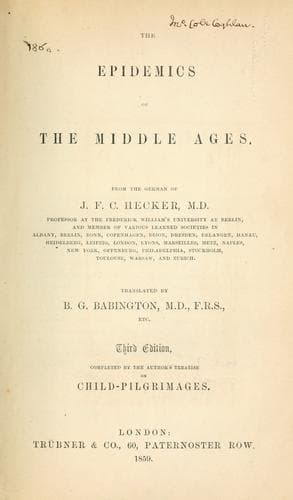
The Epidemics of the Middle AgesHecker, J. F. C. (Justus Friedrich Carl)
History
The Epidemics of the Middle Ages
Hecker, J. F. C. (Justus Friedrich Carl)
Black Death; Epidemics -- History; Hysteria, Epidemic
That her nations could so quickly overcome such a fearful concussion
in their external circumstances, and, in general, without retrograding
more than they actually did, could so develope their energies in the
following century, is a most convincing proof of the indestructibility
of human society as a whole. To assume, however, that it did not
suffer any essential change internally, because in appearance every
thing remained as before, is inconsistent with a just view of cause
and effect. Many historians seem to have adopted such an opinion;
accustomed, as usual, to judge of the moral condition of the people
solely according to the vicissitudes of earthly power, the events
of battles, and the influence of religion, but to pass over with
indifference, the great phenomena of nature, which modify, not only the
surface of the earth, but also the human mind. Hence, most of them have
touched but superficially on the “great mortality” of the 14th century.
We, for our parts, are convinced, that in the history of the world, the
Black Death is one of the most important events which have prepared the
way for the present state of Europe.
He who studies the human mind with attention, and forms a deliberate
judgment on the intellectual powers which set people and states in
motion, may, perhaps, find some proofs of this assertion in the
following observations:—at that time, the advancement of the hierarchy
was, in most countries, extraordinary; for the church acquired
treasures and large properties in land, even to a greater extent than
after the crusades; but experience has demonstrated, that such a state
of things is ruinous to the people, and causes them to retrograde, as
was evinced on this occasion.
After the cessation of the Black Plague, a greater fecundity in
women was everywhere remarkable—a grand phenomenon, which, from its
occurrence after every destructive pestilence, proves to conviction,
if any occurrence can do so, the prevalence of a higher power in the
direction of general organic life. Marriages were, almost without
exception, prolific; and double and treble births were more frequent
than at other times; under which head, we should remember the strange
remark, that after the “great mortality” the children were said to have
got fewer teeth than before; at which contemporaries were mightily
shocked, and even later writers have felt surprise.
Public-domain text, read in full here on John Shaqi.
Reviews
Reviews
No reviews yet
Be the first to share your thoughts on this work.
Join the Discussion
Join the discussion
Sign in to leave a comment or review.
Sign InorCreate an account