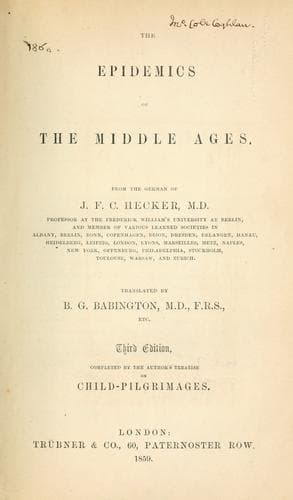
The Epidemics of the Middle AgesHecker, J. F. C. (Justus Friedrich Carl)
History
The Epidemics of the Middle Ages
Hecker, J. F. C. (Justus Friedrich Carl)
Black Death; Epidemics -- History; Hysteria, Epidemic
All the fevers which were called forth by the _pestilence_, are,
according to him, of the putrid kind; for they originate principally
from putridity of the heart’s blood, which inevitably follows the
inhalation of infected air. The Oriental Plague is, sometimes, but by
no means always, occasioned by _pestilence_ (?), which imparts to it
a character (qualitas occulta) hostile to human nature. It originates
frequently from other causes, among which, this physician was aware
that contagion was to be reckoned; and it deserves to be remarked, that
he held epidemic small-pox and measles to be infallible forerunners of
the plague, as do the physicians and people of the East[179], at the
present day.
In the exposition of his therapeutical views of the plague, a clearness
of intellect is again shewn by Santa Sofia, which reflects credit on
the age. It seemed to him to depend, 1st, on an evacuation of putrid
matters, by purgatives and bleeding: yet he did not sanction the
employment of these means indiscriminately, and without consideration;
least of all where the condition of the blood was healthy. He also
declared himself decidedly against bleeding ad deliquium (venæ sectio
eradicativa). 2d, Strengthening of the heart and prevention of
putrescence. 3d, Appropriate regimen. 4th, Improvement of the air.
5th, Appropriate treatment of tumid glands and inflammatory boils,
with emollient, or even stimulating poultices (mustard, lily-bulbs),
as well as with red-hot gold and iron. Lastly, 6th, Attention to
prominent symptoms. The stores of the Arabian pharmacy, which he
brought into action to meet all these indications, were indeed very
considerable; it is to be observed, however, that, for the most part,
gentle means were accumulated, which, in case of abuse, would do no
harm; for the character of the Arabian system of medicine, whose
principles were everywhere followed at this time, was mildness and
caution. On this account too, we cannot believe that a very prolix
treatise by Marsigli di Santa Sofia[180], a contemporary relative of
Galeazzo, on the prevention and treatment of plague, can have caused
much harm, although, perhaps, even in the 14th century, an agreeable
latitude and confident assertions respecting things which no mortal
has investigated, or which it is quite a matter of indifference to
distinguish, were considered as proofs of a valuable practical talent.
Public-domain text, read in full here on John Shaqi.
Reviews
Reviews
No reviews yet
Be the first to share your thoughts on this work.
Elsewhere in the archive
Join the Discussion
Join the discussion
Sign in to leave a comment or review.
Sign InorCreate an account