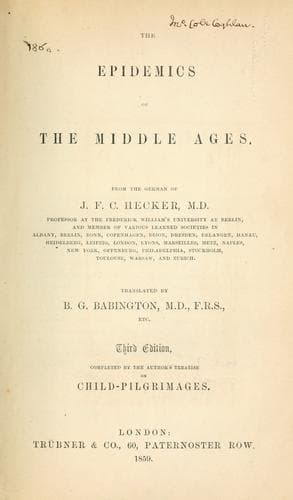
The Epidemics of the Middle AgesHecker, J. F. C. (Justus Friedrich Carl)
History
The Epidemics of the Middle Ages
Hecker, J. F. C. (Justus Friedrich Carl)
Black Death; Epidemics -- History; Hysteria, Epidemic
The agreement of contemporary and later writers, shews that the
published views of the most celebrated physicians of the 14th century,
were those generally adopted. Among these, Chalin de Vinario is
the most experienced. Though devoted to astrology, still more than
his distinguished contemporary, he acknowledges the great power of
terrestrial influences, and expresses himself very sensibly on the
indisputable doctrine of contagion, endeavouring thereby to apologize
for many surgeons and physicians of his time, who neglected their
duty[181]. He asserted boldly, and with truth, “_that all epidemic
diseases might become contagious[182], and all fevers epidemic_,” which
attentive observers of all subsequent ages have confirmed.
He delivered his sentiments on blood-letting with sagacity, as an
experienced physician; yet he was unable, as may be imagined, to
moderate the desire for bleeding shewn by the ignorant monks. He was
averse to draw blood from the veins of patients under fourteen years
of age; but counteracted inflammatory excitement in them by cupping;
and endeavoured to moderate the inflammation of the tumid glands by
leeches[183]. Most of those who were bled, died; he therefore reserved
this remedy for the plethoric; especially for the papal courtiers,
and the hypocritical priests, whom he saw gratifying their sensual
desires, and imitating Epicurus, whilst they pompously pretended to
follow Christ[184]. He recommended burning the boils with a red-hot
iron, only in the plague without fever, which occurred in single
cases[185]; and was always ready to correct those over-hasty surgeons,
who, with fire and violent remedies, did irremediable injury to their
patients[186]. Michael Savonarola, professor in Ferrara (1462),
reasoning on the susceptibility of the human frame to the influence of
pestilential infection, as the cause of such various modifications of
disease, expresses himself as a modern physician would on this point;
and an adoption of the principle of contagion was the foundation of
his definition of the plague[187]. No less worthy of observation are
the views of the celebrated Valescus of Taranta, who, during the final
visitation of the Black Death, in 1382, practised as a physician at
Montpellier, and handed down to posterity what has been repeated in
innumerable treatises on plague, which were written during the 15th and
16th centuries[188].
Public-domain text, read in full here on John Shaqi.
Reviews
Reviews
No reviews yet
Be the first to share your thoughts on this work.
Elsewhere in the archive
Join the Discussion
Join the discussion
Sign in to leave a comment or review.
Sign InorCreate an account