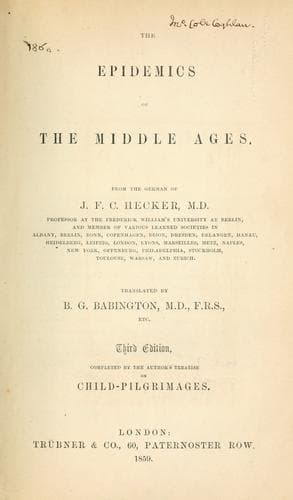
The Epidemics of the Middle AgesHecker, J. F. C. (Justus Friedrich Carl)
History
The Epidemics of the Middle Ages
Hecker, J. F. C. (Justus Friedrich Carl)
Black Death; Epidemics -- History; Hysteria, Epidemic
Of all these notions and views regarding the plague, whose development
we have represented, there are two especially, which are prominent in
historical importance:—1st, The opinion of learned physicians, that the
_pestilence_, or epidemic constitution, is the _parent of various kinds
of disease_; that the plague sometimes, indeed, but by no means always,
originates from it: that, to speak in the language of the moderns, _the
pestilence_ bears the same relation to contagion, that a predisposing
cause does to an occasional cause: and 2dly, the universal conviction
of the contagious power of that disease.
Contagion gradually attracted more notice: it was thought that in it,
the most powerful occasional cause might be avoided; the possibility of
protecting whole cities by separation, became gradually more evident;
and so horrifying was the recollection of the eventful year of the
“_Great Mortality_,” that before the close of the 14th century, ere
the ill effects of the Black Plague had ceased, nations endeavoured to
guard against the return of this enemy, by an earnest and effectual
defence.
The first regulation which was issued for this purpose, originated
with Viscount Bernabo, and is dated the 17th Jan. 1374. “Every
plague-patient was to be taken out of the city into the fields, there
to die or to recover. Those who attended upon a plague-patient, were
to remain apart for ten days, before they again associated with
any body. The priests were to examine the diseased, and point out
to special commissioners the persons infected; under punishment of
the confiscation of their goods, and of being burned alive. Whoever
imported the plague, the state condemned his goods to confiscation.
Finally, none except those who were appointed for that purpose, were to
attend plague-patients, under penalty of death and confiscation[189].”
Public-domain text, read in full here on John Shaqi.
Reviews
Reviews
No reviews yet
Be the first to share your thoughts on this work.
Elsewhere in the archive
Join the Discussion
Join the discussion
Sign in to leave a comment or review.
Sign InorCreate an account