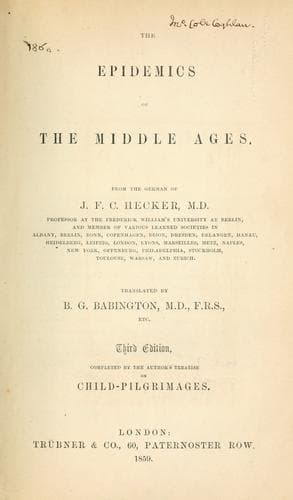
The Epidemics of the Middle AgesHecker, J. F. C. (Justus Friedrich Carl)
History
The Epidemics of the Middle Ages
Hecker, J. F. C. (Justus Friedrich Carl)
Black Death; Epidemics -- History; Hysteria, Epidemic
These orders, in correspondence with the spirit of the 14th century,
are sufficiently decided to indicate a recollection of the good effects
of confinement, and of keeping at a distance those suspected of having
plague. It was said that Milan itself, by a rigorous barricado of three
houses in which the plague had broken out, maintained itself free from
the “_Great Mortality_,” for a considerable time[190]; and examples
of the preservation of individual families, by means of a strict
separation, were certainly very frequent. That these orders must have
caused universal affliction from their uncommon severity, as we know
to have been especially the case in the city of Reggio, may be easily
conceived; but Bernabo did not suffer himself to be deterred from his
purpose by fear—on the contrary, when the plague returned in the year
1383, he forbad the admission of people from infected places into his
territories, on pain of death[191]. We have now, it is true, no account
how far he succeeded; yet it is to be supposed that he arrested the
disease, for it had long lost the property of the Black Death, to
spread abroad in the air the contagious matter which proceeded from the
lungs, charged with putridity, and to taint the atmosphere of whole
cities by the vast numbers of the sick. Now that it had resumed its
milder form, so that it infected only by contact, it admitted being
confined within individual dwellings, as easily as in modern times.
Bernabo’s example was imitated; nor was there any century more
appropriate for recommending to governments strong regulations against
the plague, than the 14th; for when it broke out in Italy, in the year
1399, and still demanded new victims, it was for the 16th time; without
reckoning frequent visitations of measles and small-pox. In this same
year, Viscount John, in milder terms than his predecessor, ordered that
no stranger should be admitted from infected places, and that the city
gates should be strictly guarded. Infected houses were to be ventilated
for at least eight or ten days, and purified from noxious vapours
by fires, and by fumigations with balsamic and aromatic substances.
Straw, rags, and the like, were to be burned; and the bedsteads which
had been used, set out for four days in the rain or the sunshine, so
that, by means of the one or the other, the morbific vapour might be
destroyed. No one was to venture to make use of clothes or beds out of
infected dwellings, unless they had been previously washed and dried
either at the fire or in the sun. People were, likewise, to avoid,
as long as possible, occupying houses which had been frequented by
plague-patients[192].
Public-domain text, read in full here on John Shaqi.
Reviews
Reviews
No reviews yet
Be the first to share your thoughts on this work.
Elsewhere in the archive