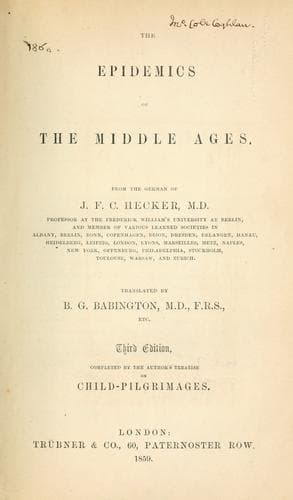
The Epidemics of the Middle AgesHecker, J. F. C. (Justus Friedrich Carl)
History
The Epidemics of the Middle Ages
Hecker, J. F. C. (Justus Friedrich Carl)
Black Death; Epidemics -- History; Hysteria, Epidemic
Medicine extends not so far. The remains of animals make us indeed
acquainted, even now, with diseases to which the brute creation was
subject long ere the waters overflowed, and the mountains sunk; but
the investigation which is our more immediate object, scarcely reaches
to the beginning of human culture. Records of remote and of proximate
eras, lie before us in rich abundance. They speak of the deviations
and destructions of human life, of exterminated and newly-formed
nations; they lay before us stupendous facts, which we are called
upon to recognise and expound in order to solve this exalted problem.
If physicians cannot boast of having unrolled these records with the
avidity of true explorers of Nature, they may find some excuse in the
nature of the inquiry—for the characters are dead, and the spirits of
which they are the magic symbols, manifest themselves only to him
who knows how to adjure them. Epidemics leave no corporeal traces;
whence their history is perhaps more intellectual than the science
of the Geologist, who, on his side, possesses the advantage of
treating on subjects which strike the senses, and are therefore more
attractive,—such as the impressions of plants no longer extant, and the
skeletons of lost races of animals. This, however, does not entirely
exculpate us from the charge of neglecting our science, in a quarter
where the most important facts are to be unveiled. It is high time to
make up for what has been left unaccomplished, if we would not remain
idle and mean-spirited in the rear of other naturalists.
I was animated by these and similar reflections, and excited too by
passing events, when I undertook to write the history of the “Black
Death.” With some anxiety, I sent this book into the world, for it
was scarcely to be expected that it would be everywhere received with
indulgence, since it belonged to an hitherto unknown department of
historical research, the utility of which might not be obvious in our
practical times. Yet I soon received encouragement, not only from
learned friends, but also from other men of distinguished merit, on
whose judgment I placed great reliance; and thus I was led to hope that
it was not in vain, and without some advantage to science, that I had
unveiled the dismal picture of a long departed age.
Public-domain text, read in full here on John Shaqi.
Reviews
Reviews
No reviews yet
Be the first to share your thoughts on this work.
Join the Discussion
Join the discussion
Sign in to leave a comment or review.
Sign InorCreate an account