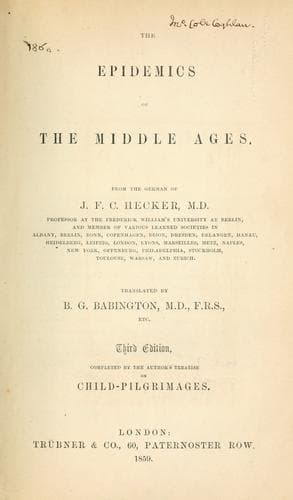
The Epidemics of the Middle AgesHecker, J. F. C. (Justus Friedrich Carl)
History
The Epidemics of the Middle Ages
Hecker, J. F. C. (Justus Friedrich Carl)
Black Death; Epidemics -- History; Hysteria, Epidemic
This work I have followed up by a treatise on a nervous disorder,
which, for the first time, appeared in the same century, as an
epidemic, with symptoms that can be accounted for only by the spirit of
the Middle Ages—symptoms which, in the manner of the diffusion of the
disease among thousands of people, and of its propagation for more than
two centuries, exercised a demoniacal influence over the human race,
yet in close, though uncongenial alliance, with kindlier feelings.
I have prepared materials for various other subjects, so far as the
resources at my disposal extend, and I may hope, if circumstances prove
favourable, to complete by degrees, the history of a more extensive
series of Epidemics on the same plan as the “Black Death,” and the
“Dancing Mania.”
Amid the accumulated materials which past ages afford, the powers and
the life of one individual, even with the aid of previous study, are
insufficient to complete a comprehensive history of Epidemics. The
zealous activity of many must be exerted if we would speedily possess
a work which is so much wanted in order that we may not encounter
new epidemics with culpable ignorance of analogous phenomena. How
often has it appeared on the breaking out of epidemics, as if the
experience of so many centuries had been accumulated in vain. Men gazed
at the phenomena with astonishment, and even before they had a just
perception of their nature, pronounced their opinions, which, as they
were divided into strongly opposed parties, they defended with all the
ardour of zealots, wholly unconscious of the majesty of all-governing
nature. In the descriptive branches of natural history, a person would
infallibly expose himself to the severest censure, who should attempt
to describe some hitherto unknown natural production, whether animal or
vegetable, if he were ignorant of the allied genera and species, and
perhaps neither a botanist nor zoologist; yet an analogous ignorance of
epidemics, in those who nevertheless discussed their nature, but too
frequently occurred, and men were insensible to the justest reproof.
Thus it has ever been, and for this reason we cannot apply to ourselves
in this department, the significant words of Bacon, that we are the
ancients, and our forefathers the moderns, for we are equally remote,
with them, from a scientific and comprehensive knowledge of epidemics.
This might, and ought to be otherwise, in an age which, in other
respects, may, with justice, boast of a rich diversity of knowledge,
and of a rapid progress in the natural sciences.
Public-domain text, read in full here on John Shaqi.
Reviews
Reviews
No reviews yet
Be the first to share your thoughts on this work.
Join the Discussion
Join the discussion
Sign in to leave a comment or review.
Sign InorCreate an account