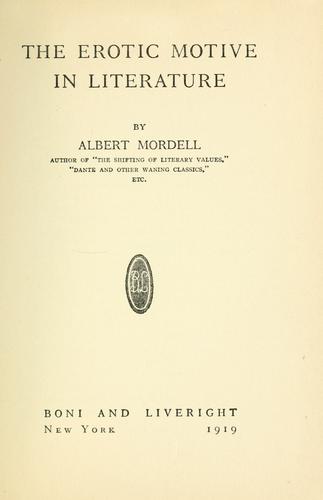
Erotic literature -- History and criticism; Psychoanalysis and literature; Sex in literature
Byron and Shelley have had more imitators and lovers than any of the
poets of England of their time. We know the influence of each of them
on Tennyson and Browning respectively, though the Victorians later
departed from the footsteps of their masters and became conservative.
But the causes that made Heine, Leonardi, De Musset and Pushkin love
Byron were the same as those which drew to Shelley, the republican
melodist Swinburne, James Thomson, the atheist author of the _City of
Dreadful Night_, Francis Thompson, the Catholic maker of beautiful
forms out of his own sufferings, and the unhappy lyricist Beddoes, who
committed suicide. The later poets found Byron and Shelley singers of
unconscious wishes of their own, portrayers of moods and sorrows like
those they felt and constructors of means of ridding the world of such
griefs by plans they largely approved.
The reason for the universal appeal of the Bible is because of the
variety in this library of books; there is always some chapter that
expresses our unconscious wishes.
The _Old Testament_, especially, satisfies our unconscious. This is
due to the psalms voicing human sorrow, and the prophecies of Isaiah
ringing with a passionate love for justice, to the pleasant tales that
appeal to our youthful fancy like those of Joseph and his brethren, and
Ruth, and the philosophical drama of Job, in whose sufferings we see
our own, to the epicureanism and melancholy in Ecclesiasticus, and the
military exploits of Joshua and David. The Bible appeals as literature
to many who do not believe in dogma or miracles, to many who find parts
of it cruel and unjust because it is a varied collection of books, and,
as a result, the unconscious wishes and means of gratification of some
of the writers must meet our own, separated as we are from them by
thousands of years.
When we read that Wordsworth soothed De Quincey and John Stuart Mill,
and had a tonic effect on Arnold, so that he became a leading disciple,
that Shaw based his wit and philosophy on Samuel Butler, an almost
forgotten contemporary, that Brandes found an affinity in writers like
Shakespeare and Ibsen, we are aware that the process is the same:
the later author found some earlier one who especially expressed his
unconscious wishes.
Take the literary influences in literature, that of Smollet on Dickens,
that of Dickens on Daudet and Dostoievsky and Bret Harte, that of
Balzac on Flaubert, of Flaubert on Maupassant and Zola, of Carlyle on
Ruskin and Froude, of Kipling on Jack London. All this means that the
author influenced found in his master a kindred sufferer and a kindred
dreamer.
Public-domain text, read in full here on John Shaqi.
Reviews
Reviews
No reviews yet
Be the first to share your thoughts on this work.
Elsewhere in the archive
Join the Discussion
Join the discussion
Sign in to leave a comment or review.
Sign InorCreate an account