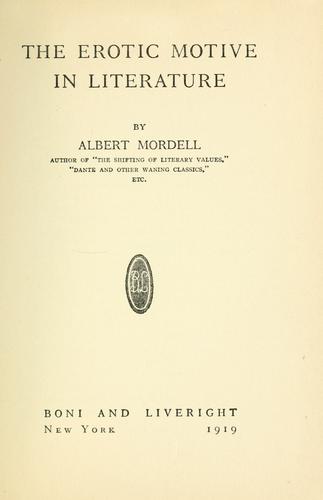
Erotic literature -- History and criticism; Psychoanalysis and literature; Sex in literature
Stress has never been laid on the real unconscious origins of some of
Keats's best poems. We know that his sad love affair with Fanny Brawne,
who coquetted with him, inspired a few poems directly addressed to her;
it is also indisputable that Keats had her in mind when he wrote _La
Belle Dame Sans Merci_, he was telling of his own fate in the account
of the knight's mishap. But it is rarely recognised that emotions
connected with Fanny Brawne inspired his two most famous odes, the one
to the Nightingale and the other to the Grecian urn; that the tale of
_Lamia_, which ranks among his best poems, is a symbolic description
of his attitude towards Miss Brawne, and that her presence is felt in
other poems and sonnets by Keats. He thought of her constantly, and he
could scarcely write a love poem but she somehow or other stepped into
the pages. When we compare these and other poems to the letters that
he had written to her about the same time, we will find that often the
same emotions inspired both.
Keats met Miss Brawne in the fall of 1818, when he was twenty-three
years old. He quarrelled with her in February, 1819, but, nevertheless,
was her declared lover in the spring. His first love letter that we
have to her is dated July 1, 1819, and the last about May, 1820. In
the spring and summer of 1819 he wrote some of his best poems, and
he showed most emphatically the repression of his emotions by the
coquetries of Fanny. He took a walk among the marbles of the British
Museum, in February, 1819, and three months later penned his _Ode to a
Grecian Urn_. In the latter part of April he heard the nightingale in
Brown's garden, and he wrote the famous ode. In the same month he also
wrote _La Belle Dame Sans Merci_. In August and September of 1819 he
worked on _Lamia_. He had his first hemorrhage in February, 1820, left
England in September, and died in Italy February, 1821.
Those who have read the letters to Fanny will remember with what
anxiety the poet wrote, how he showed his jealousy and complained and
pleaded without pride. In one letter dated June 19, 1819, he said he
would resent having his heart made a football, that Brown, with whom
she flirted, was doing him to death by inches, and that the air of a
room from which Fanny was absent was unhealthy to him. "I appeal to
you by the blood of that Christ you believe in.... Do not write to me
if you have done anything this month which it would have pained me to
have seen." In October he writes, "Love is my religion--I could die for
that; I could die for you." The letters are the record of the agony of
a man who is being played with and who cries out in helplessness. He
cannot bear seeing her smiling with others or dancing with them. Miss
Brawne asserted after his death that she did not regard him as a great
poet, and thought it advisable for people to let his reputation die. It
is also said she referred to him as the foolish poet who loved her.
Let us see how this sad affair influenced his work.
Public-domain text, read in full here on John Shaqi.
Reviews
Reviews
No reviews yet
Be the first to share your thoughts on this work.
Elsewhere in the archive
Join the Discussion
Join the discussion
Sign in to leave a comment or review.
Sign InorCreate an account