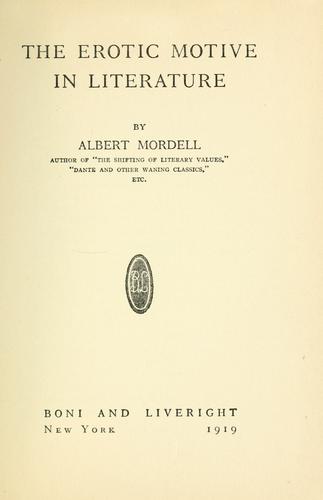
Erotic literature -- History and criticism; Psychoanalysis and literature; Sex in literature
The one moral tale Poe wrote, _William Wilson_, also has great value
to the psychoanalyst. For it is a study of emotional conflicts and
deals with the subject of dual personality and anticipates Stevenson's
famous story, _Dr. Jekyll and Mr. Hyde_. Poe is William Wilson, and
he even describes his school days in England in the tale. It is the
history of Poe's own struggle with his unconscious, with evil. He too
was a gambler and probably cheated at cards like William Wilson. There
are two William Wilsons, one representative of the unprincipled, the
criminal, the unconscious primitive instincts in ourselves, and the
other William Wilson who is the voice of civilisation, the conscious
moralist seeking to repress the other. Surely this great tale is
symbolic of man's struggle with his own conscious which civilisation
trying to tame.
So we leave Poe. Others may take up the question of his alleged
drunkenness and its overestimated effect on his art. But I have merely
wished to point a few things in his work made clear with the help of
psychoanalysis. Psychoanalysis has given the answer to those who object
to Poe because of his lack of moral tone.
It should be added that Poe's great attachment to his mother-in-law,
Mrs. Clemm, was due to the loss of his own mother in infancy.
Poe's devotion and love for women of his later life, Mrs. Osgood, Mrs.
Richmond, Mrs. Lewis, and especially Helen Whitman, did not influence
his work considerably in spite of the sufferings they caused him, but
produced a few good single poems to some of them, notably, _To Annie_,
Mrs. Richmond, and _To Helen_, Mrs. Whitman, and the pathetic, masterly
letters to these women.
FOOTNOTE:
[H] He honoured Mrs. Osgood in the same way by republishing another
poem from the _Southern Literary Messenger_ of September, 1835,
written for some Eliza and opening "Eliza, let thy generous heart."
This poem in the poetical works of Poe bears the title, "Lines Written
in an Album." It originally was written, Woodberry surmises, to his
employer's daughter, Eliza White, though Whitty believes it was
addressed to his future wife, Virginia Eliza Clemm. Yet it is very
likely the poem was written to one of his early sweethearts, Elizabeth
Herring.
CHAPTER XVII
THE IDEAS OF LAFCADIO HEARN
I
Lafcadio Hearn anticipated many of Freud's conclusions. He understood
the unity of life, in the past with that in the present, and his most
persistent thought is the power and influence of the emotional life of
our very distant ancestors upon our own lives.
Public-domain text, read in full here on John Shaqi.
Reviews
Reviews
No reviews yet
Be the first to share your thoughts on this work.
Elsewhere in the archive
Join the Discussion
Join the discussion
Sign in to leave a comment or review.
Sign InorCreate an account