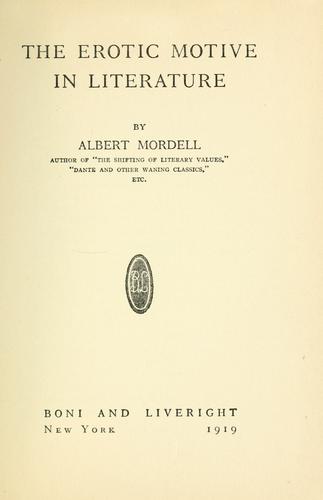
Erotic literature -- History and criticism; Psychoanalysis and literature; Sex in literature
A word should be said about Hearn's antecedents. He has himself left
a tribute to his mother, who exerted a great influence upon him. She
was a Greek, though one biographer, Nina Kennard, conjectures that
she had oriental blood. Hearn was very much attached to her and lost
her when he was only six years old by his father divorcing her. This
event coloured his entire life. He tells us that there was a miniature
painting in oil of the Virgin and the Child, on the wall of the room in
which he slept as a child. "I fancied," he says, "that the brown Virgin
represented my mother--whom I had almost completely forgotten--and the
large-eyed child myself." In this infantile phantasy we see how the
repressed love for his mother revived in him and how he identified her
with the Virgin.
He wrote to his brother: "My love of right, my hate of wrong;--my
admiration for what is beautiful or true;--my capacity for faith in man
or woman;--my sensitiveness to artistic things which gives me whatever
little success I have;--even that language-power, whose physical sign
is in the large eyes of both of us,--came from her. It is the mother
who makes us,--makes at least all that makes the nobler man; not his
strength or powers of calculation, but his heart and power to love. And
I would rather have her portrait than a fortune."
Hearn knew of the existence of the unconscious in the Freudian sense,
and also of its influence on authorship. When he was twenty-eight, in
1878, in a letter to Mr. Krehbiel he said: "Every one has an inner
life of his own,--which no other eye can see, and the great secrets
of which are never revealed, although occasionally when we create
something beautiful, we betray a faint glimpse of it--sudden and brief,
as of a door opening and shutting in the night." (_Life and Letters_,
Volume 1, p. 196.) "_Unconscious_ brain-work is the best to develop
... latent feeling or thought. By quietly writing the thing over and
over again, I find that the emotion or idea often _develops itself_ in
the process,--unconsciously. When the best result comes, it ought to
surprise you, for our best work is out of the Unconscious." (_Life and
Letters_, Volume 1, p. 140-141.)
Public-domain text, read in full here on John Shaqi.
Reviews
Reviews
No reviews yet
Be the first to share your thoughts on this work.
Elsewhere in the archive
Join the Discussion
Join the discussion
Sign in to leave a comment or review.
Sign InorCreate an account