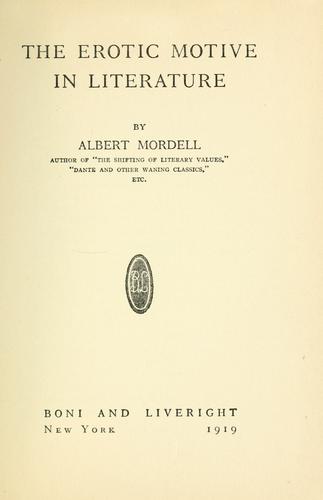
Erotic literature -- History and criticism; Psychoanalysis and literature; Sex in literature
Again Hearn realised that fairy tales had their origin in dreams, an
idea that has been developed by Rank, Abraham and Ricklin, disciples
of Freud. Hearn saw that there was an intimate connection between
literature and dreams. He is one of the first men to have seen the
relation between dreams and supernatural literature. The following
passages are from the lecture on "The Supernatural in Literature"
in the second volume of _Interpretation of Literature_. "Whether
you believe in ghosts or not, all the artistic elements of ghostly
literature exist in your dreams, and form a veritable treasury of
literary material for the man that knows how to use them." "Trust to
your own dream life; study it carefully, and draw your inspiration from
that. For dreams are the primary source of almost everything that is
beautiful in the literature which treats of what lies beyond mere daily
experience."
Hearn, with Samuel Butler, is one of the great champions for the
theory about the power of unconscious memory over us. This idea is
one of the axioms of psychoanalysis, or rather one of its pillars. In
his essay, "About Ancestor Worship" in _Kokoro_, Hearn develops his
theories of inherited memory at length, and one might say that there
is scarcely an essay of his that does not touch on the subject. Here
he states one of the leading lessons taught by psychoanalysis. Hearn
realised that we should not starve all our primitive tendencies, as
this would lead to the destruction of some of the highest emotional
faculties with which they are blended. The animal tendencies must be
partly extirpated and partly sublimated. This is practically Freud's
theory that neurosis is produced by trying to stamp out our sexual
impulses (yet Freud does not mean that we should give these full play).
The following passage from Hearn's essay is part of the prophylaxis
of psychoanalysis. "Theological legislation, irrationally directed
against human weaknesses, has only aggravated social disorders; and
laws against pleasure have only provoked debaucheries. The history
of morals teaches very plainly indeed that our bad Kami require some
propitiation. The passions still remain more powerful than the reason
in man because they are incomparably older, because they were once all
essential to self-preservation,--because they made that primal stratum,
of consciousness out of which the nobler sentiments have slowly grown.
Never can they be suffered to rule; but woe to whosoever would deny
their immemorial rights."
He has a similar idea in his essay on "Nirvana." "Mental and moral
advance has thus far been effected only through constant struggles
older than reason or moral feeling,--against the instincts and
appetites of primitive brute life.... Only through millions of births
have we been able to reach this our present imperfect state; and the
dark bequests of our darkest past are still strong enough betimes to
prevail over reason and ethical feeling."
Public-domain text, read in full here on John Shaqi.
Reviews
Reviews
No reviews yet
Be the first to share your thoughts on this work.
Elsewhere in the archive
Join the Discussion
Join the discussion
Sign in to leave a comment or review.
Sign InorCreate an account