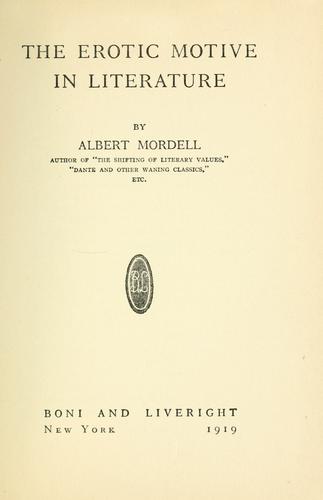
Erotic literature -- History and criticism; Psychoanalysis and literature; Sex in literature
Hearn regarded man as an entity of millions of cells, a composite of
multiples of lives carrying out unconsciously the behests of past ages.
Man's instincts are but unconscious memories of the instincts of old.
Whitman has this idea in his _Song of Myself_, and Buddha taught this
idea which Hearn calls "the highest truth ever taught to man," "the
secret unity of life." Hearn states the view fully in his remarkable
essay on Dust. "All our emotions and thoughts and wishes, however,
changing and growing through the varying seasons of life, are only
compositions and recompositions of the sensations and ideas and desires
of other folk, mostly of dead people.--I an individual,--an individual
soul! Nay, I am a population--a population unthinkable for multitude,
even by groups of a thousand millions! Generations of generations I
am, æons of æons." Or as he states it in another essay, "Ideas of
Pre-existence," in _Kokoro_: "It is incontrovertible that in every
individual brain is locked up the inherited memory of the absolutely
inconceivable multitude of experiences received by all the brains of
which it is the descendant." There are similar ideas in Jack London's
_Star Rover_.
Hearn laid emphasis on the unity of the past and present, a fundamental
principle of psychoanalysis. Hearn saw this idea in Buddhism and hence
became attached to the philosophy of this creed, and his reconciliation
of it with the theory of evolution is no mere idle dream. Leading
Buddhist scholars before Hearn saw the similarity between the theory
of heredity as taught by evolution and the doctrine of Karma or
transmigration of character. This doctrine of Karma explains also that
a man has pernicious unconquered evil instincts because he is allied to
ancestors who possessed them strongly. Buddhism taught the theory found
in evolution and psychoanalysis, that we contain in ourselves every
moral tendency and psychic attribute of millions of people and animals
from whom we have descended. We are full of shreds of our ancestors'
emotions and characteristics which are buried in our unconscious.
II
Public-domain text, read in full here on John Shaqi.
Reviews
Reviews
No reviews yet
Be the first to share your thoughts on this work.
Elsewhere in the archive
Join the Discussion
Join the discussion
Sign in to leave a comment or review.
Sign InorCreate an account