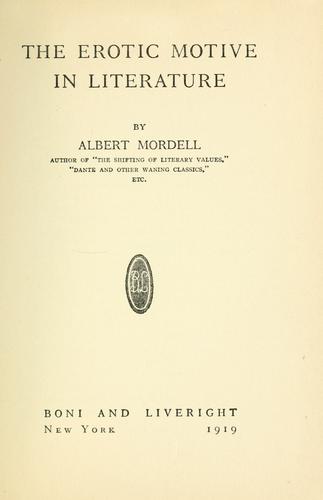
Erotic literature -- History and criticism; Psychoanalysis and literature; Sex in literature
Why does Hearn harp on this idea of unconscious memory throughout his
work and in his correspondence? Why was he attracted to the question
of the eternal persistence of life even before he accepted the
philosophy of Buddhism. His pet theory was that nothing could be lost
in the universe. In one of his finest essays, "Reverie," in _Kotto_,
he gives us the secret of his life. He tells that the mother's smile
will survive everything, for life can never disappear finally from the
universe. He first states the materialistic position which assumes that
eventually all life will die and naught will be left of our labours
and struggles, and then he gives the Buddhistic idea, which holds that
nothing is lost in the universe. I think in this essay we have the
keynote to Hearn's philosophy. He lost faith in Christianity early and
with it a belief in the immortality of the individual soul. At the age
of six, he lost his mother, whom he loved, and his scepticism on the
subject of immortality made him feel that his mother was gone from him
eternally. This was painful to him and He accepted the philosophy of
Buddhism as a solace, for it taught something that was not repugnant
to his scientific sense; that life can never die out entirely, for the
universe always would exist and even if life died out on our planet,
those conditions that made it prevail here would reign either in some
other part of the universe or at a later time. Hence we all would
contribute to that life as our ancestors contribute to our lives. In
fact, Hearn once wrote he would not object to being transformed into an
insect. So if life went on forever he would still know that mother's
smile he had lost in infancy. The _Reverie_ essay is the result of his
Œdipus Complex.
In fact, Hearn formulated the idea of the Eternal Recurrence in 1880
before Nietzsche did, who wept when he discovered this by no means
new theory in August, 1881, at Silas Maria, 6,500 feet above sea.
Hearn's essay on Metempsychosis appeared in the New Orleans _Item_ and
was included in a collection published called _Fantastics and Other
Fantasies_. But Nietzsche became intensely pessimistic as the result of
his discovery, since it meant all life's tragedies would also recur.
Hearn, no doubt, abandoned the theory as a literal possibility after he
read Spencer, but he retained his belief in some of the main features
of it.
Public-domain text, read in full here on John Shaqi.
Reviews
Reviews
No reviews yet
Be the first to share your thoughts on this work.
Elsewhere in the archive
Join the Discussion
Join the discussion
Sign in to leave a comment or review.
Sign InorCreate an account