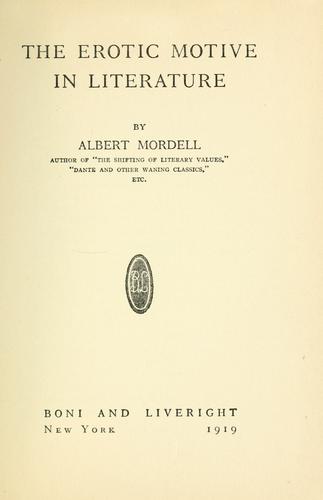
Erotic literature -- History and criticism; Psychoanalysis and literature; Sex in literature
When we recall that Buckle, who was a free thinker in religious
matters, still clung to the idea of immortality of the soul because he
could not tolerate the thought of never meeting his dead mother; when
we remember that scientists like Wallace and Fiske, who were among the
pioneers of the theory of evolution, finally embraced spiritualism as
a compensation for their lost faith in religion, it should not appear
fantastic to trace Hearn's views on unconscious inherited memory and on
the Buddhistic conception of Metempsychosis, to his loss of both his
mother and his religion; for in his new belief he could meet his mother
and still not sacrifice his intellect to his belief.
Psychoanalysis might be applied to other phases of Hearn's
writings,--his interest in the gruesome and exotic. It can explain his
interest in other races like the coloured people and the Japanese; his
passion for physical beauty and his shyness. One thing that impresses
the lover of Hearn is the seeming impersonality of his work. Yet
though he says little of himself directly, you can see the sensitive,
half-blind sufferer throughout the work. For his ideas studied and
traced to their source reveal of themselves the reasons why he embraced
them.
He has described ideal love, such no doubt as he must have felt, in
_Karma_ in _Lippincott's Magazine_, May, 1890. This story has been only
recently published in book form.
His affinity for Poe and his adoption of the name The Raven in his
letters to Mr. Watkins is seen in the projecting of himself upon
that unhappy genius with whom he had so much in common. He, like
Poe, suffered from poverty, from following aristocratic traditions
in intellectual pursuit, in a devotion to physical beauty, in a love
for French literature, in an interest in extreme suffering, in the
divesting of art from morals and in wandering about from city to city.
CHAPTER XVIII
CONCLUSION
I
The question now arises, What effect will a knowledge of the author's
unconscious have in making us appreciate his work as literature? Does
it matter at all if we know whether a particular affair or a certain
woman inspired a poem or not? Many critics protest against the kind
of literary criticism that speculates as to whether the heroines
celebrated in the sonnets of Shakespeare or Sidney were real or
imaginary, whether the emotions felt by the poets were affected or
genuine. These critics are not usually inclined to admit any connection
between an author's life and his work.
Public-domain text, read in full here on John Shaqi.
Reviews
Reviews
No reviews yet
Be the first to share your thoughts on this work.
Elsewhere in the archive
Join the Discussion
Join the discussion
Sign in to leave a comment or review.
Sign InorCreate an account