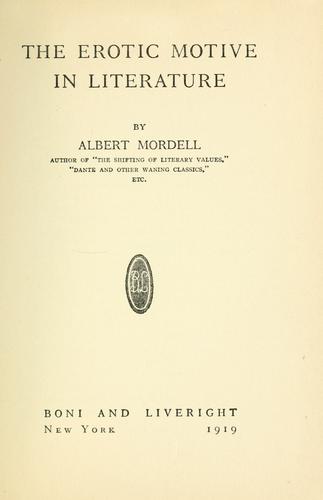
Erotic literature -- History and criticism; Psychoanalysis and literature; Sex in literature
One of the great factors in helping us understand literary works
is an acquaintance with some of the episodes of the author's life.
Sainte-Beuve revolutionised literary criticism by his dictum that
the knowledge of an author's life helps us to follow his work the
better. Dr. Johnson once said that he liked the biographical side
of literature. Isaac D'Israeli, before Sainte-Beuve, showed in his
_Literary Character_ that he grasped the nature of the intimate
relationship between an author and his work.
It is our contention that a literary work is better appreciated after
the facts about an author's life are revealed to us, and this does
not usually happen for years after his death. One of the reasons why
masterpieces cannot be fully comprehended in an author's lifetime is
because we do not know altogether how he came to write the works in
question. Shelley and Keats were not fully understood by the critics
of their times not only because of their radical views, but because
the public did not know the details of the poets' relations with their
parents, and the women they loved. How could a cold, stern reviewer
find anything in _Epipsychidion_ or _Lamia_ unless he was aware of some
facts about Emilia Viviani or Fanny Brawne? How was any fair estimate
of either of these poets possible while the information that later
times have furnished was not at hand? Many people objected when the
letters of Keats to Fanny Brawne were published forty years ago, but
these have helped us to understand that the cry that pervades them
is the same embodied in music in the _Ode to Fanny_, the _Ode to the
Nightingale_ and in _Lamia_.
No true estimate of a man is possible till one reads the plaints of
his that were not meant for the public. We should not regret the
publication of the love letters of the Brownings and Carlyles. Those
wonderful letters are almost as good literature as anything the authors
wrote for the public. We are enabled to see the writers in an entirely
different light from that in which their own works put them, and to
understand these better.
It was not possible for the age in which Balzac and Goethe lived, fully
to appreciate them, for it did not have their published correspondence,
and could not estimate the close connection between unknown episodes in
their lives and their works. I do not mean that the contemporaries of
these poets could not recognise the fact that these men were geniuses,
but they could not get a proper understanding of them.
Public-domain text, read in full here on John Shaqi.
Reviews
Reviews
No reviews yet
Be the first to share your thoughts on this work.
Elsewhere in the archive
Join the Discussion
Join the discussion
Sign in to leave a comment or review.
Sign InorCreate an account