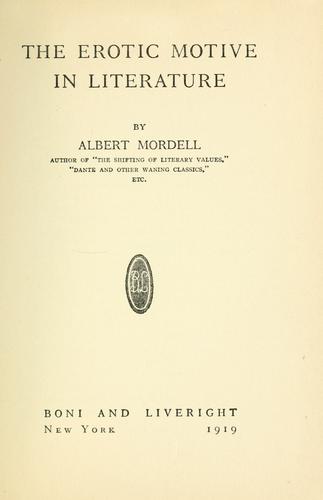
Erotic literature -- History and criticism; Psychoanalysis and literature; Sex in literature
In former times criticism was busy with the questions of technique,
with matters of rhetoric and grammar; a writer's work furnished
opportunities for discussing how near to old ideas of authorship
the author approached. To-day we study an author in connection with
his own life and with ours. The Shakespearean criticism of the last
century is worth more than that of the two centuries following his
death. Coleridge and Hazlitt devoted their discussions to showing how
the great poet discussed problems that touched all of us. A number
of studies and books have been published which seek to educe his
personality from his work. I believe Walter Bagehot was a pioneer
in this kind of work. His essay on _Shakespeare--The Man_ appeared
as early as 1853. The most successful venture of this kind has been
George Brandes's great study. Other works of this nature are Frank
Harris's _The Man Shakespeare_, and _The Women of Shakespeare_, both
usually regarded as fantastic, but nevertheless deserving credit for
their daring, mistaken as they often are. Leslie Stephen's and A. C.
Bradley's essays in the _Studies of a Biographer_ and _Oxford Lectures
on Poetry_, respectively deserve special mention. Then there are books
like David Masson's _Shakespeare Personally_, Robert Waters's _William
Shakespeare, Portrayed by Himself_, and Goldwin Smith's _Shakespeare:
The Man_. Shakespeare's greatness can be recognised though we knew
little about him, yet the keynote of modern Shakespearean criticism is
to endeavour to see the connection between the plays and the man.
Public-domain text, read in full here on John Shaqi.
Reviews
Reviews
No reviews yet
Be the first to share your thoughts on this work.
Elsewhere in the archive
Join the Discussion
Join the discussion
Sign in to leave a comment or review.
Sign InorCreate an account