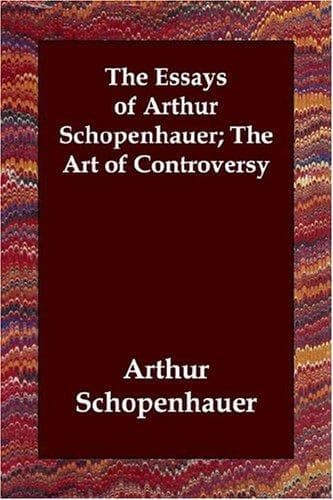
The Essays of Arthur Schopenhauer; the Art of Controversy — John Shaqi
The Essays of Arthur Schopenhauer; the Art of ControversySchopenhauer, Arthur
Philosophy
The Essays of Arthur Schopenhauer; the Art of Controversy
Schopenhauer, Arthur
Debates and debating; Logic
For example, your opponent states that in the original formation of a
mountain-range the granite and other elements in its composition were,
by reason of their high temperature, in a fluid or molten state; that
the temperature must have amounted to some 480° Fahrenheit; and that
when the mass took shape it was covered by the sea. You reply, by an
argument _ad auditores_, that at that temperature--nay, indeed, long
before it had been reached, namely, at 212° Fahrenheit--the sea would
have been boiled away, and spread through the air in the form of
steam. At this the audience laughs. To refute the objection, your
opponent would have to show that the boiling-point depends not only on
the degree of warmth, but also on the atmospheric pressure; and that
as soon as about half the sea-water had gone off in the shape of
steam, this pressure would be so greatly increased that the rest of it
would fail to boil even at a temperature of 480°. He is debarred from
giving this explanation, as it would require a treatise to demonstrate
the matter to those who had no acquaintance with physics.
XXIX.[1]
[Footnote 1: See § xviii.]
If you find that you are being worsted, you can make a
_diversion_--that is, you can suddenly begin to talk of something
else, as though it had a bearing on the matter in dispute, and
afforded an argument against your opponent. This may be done without
presumption if the diversion has, in fact, some general bearing on the
matter; but it is a piece of impudence if it has nothing to do with
the case, and is only brought in by way of attacking your opponent.
For example, I praised the system prevailing in China, where there is
no such thing as hereditary nobility, and offices are bestowed only on
those who succeed in competitive examinations. My opponent maintained
that learning, as little as the privilege of birth (of which he had a
high opinion) fits a man for office. We argued, and he got the worst
of it. Then he made a diversion, and declared that in China all
ranks were punished with the bastinado, which he connected with the
immoderate indulgence in tea, and proceeded to make both of them a
subject of reproach to the Chinese. To follow him into all this would
have been to allow oneself to be drawn into a surrender of the victory
which had already been won.
The diversion is mere impudence if it completely abandons the point in
dispute, and raises, for instance, some such objection as "Yes, and
you also said just now," and so on. For then the argument becomes to
some extent personal; of the kind which will be treated of in the last
section. Strictly speaking, it is half-way between the _argumentum
ad personam_, which will there be discussed, and the _argumentum ad
hominem_.
Public-domain text, read in full here on John Shaqi.
Reviews
Reviews
No reviews yet
Be the first to share your thoughts on this work.
Join the Discussion
Join the discussion
Sign in to leave a comment or review.
Sign InorCreate an account