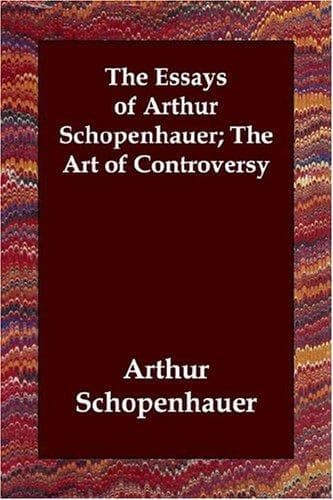
The Essays of Arthur Schopenhauer; the Art of Controversy — John Shaqi
The Essays of Arthur Schopenhauer; the Art of ControversySchopenhauer, Arthur
Philosophy
The Essays of Arthur Schopenhauer; the Art of Controversy
Schopenhauer, Arthur
Debates and debating; Logic
Nevertheless, in a dispute with ordinary people, we may employ
universal opinion as an authority. For it will generally be found that
when two of them are fighting, that is the weapon which both of them
choose as a means of attack. If a man of the better sort has to deal
with them, it is most advisable for him to condescend to the use
of this weapon too, and to select such authorities as will make an
impression on his opponent's weak side. For, _ex hypoihesi_, he is as
insensible to all rational argument as a horny-hided Siegfried, dipped
in the flood of incapacity, and unable to think or judge. Before
a tribunal the dispute is one between authorities alone,--such
authoritative statements, I mean, as are laid down by legal experts;
and here the exercise of judgment consists in discovering what law or
authority applies to the case in question. There is, however, plenty
of room for Dialectic; for should the case in question and the law not
really fit each other, they can, if necessary, be twisted until they
appear to do so, or _vice versa_.
XXXI.
If you know that you have no reply to the arguments which your
opponent advances, you may, by a fine stroke of irony, declare
yourself to be an incompetent judge: "What you now say passes my
poor powers of comprehension; it may be all very true, but I can't
understand it, and I refrain from any expression of opinion on it." In
this way you insinuate to the bystanders, with whom you are in good
repute, that what your opponent says is nonsense. Thus, when Kant's
_Kritik_ appeared, or, rather, when it began to make a noise in the
world, many professors of the old ecclectic school declared that they
failed to understand it, in the belief that their failure settled the
business. But when the adherents of the new school proved to them that
they were quite right, and had really failed to understand it, they
were in a very bad humour.
This is a trick which may be used only when you are quite sure that
the audience thinks much better of you that of your opponent. A
professor, for instance may try it on a student.
Strictly, it is a case of the preceding trick: it is a particularly
malicious assertion of one's own authority, instead of giving reasons.
The counter-trick is to say: "I beg your pardon; but, with your
penetrating intellect, it must be very easy for you to understand
anything; and it can only be my poor statement of the matter that is
at fault"; and then go on to rub it into him until he understands it
_nolens volens_, and sees for himself that it was really his own fault
alone. In this way you parry his attack. With the greatest politeness
he wanted to insinuate that you were talking nonsense; and you, with
equal courtesy, prove to him that he is a fool.
XXXII.
Public-domain text, read in full here on John Shaqi.
Reviews
Reviews
No reviews yet
Be the first to share your thoughts on this work.
Join the Discussion
Join the discussion
Sign in to leave a comment or review.
Sign InorCreate an account