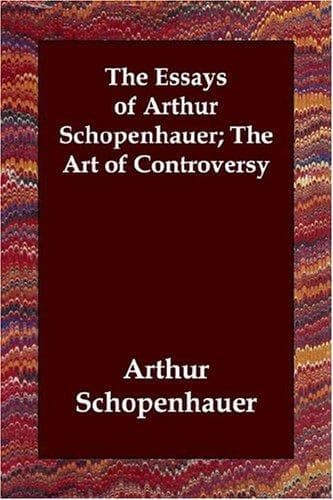
The Essays of Arthur Schopenhauer; the Art of Controversy — John Shaqi
The Essays of Arthur Schopenhauer; the Art of ControversySchopenhauer, Arthur
Philosophy
The Essays of Arthur Schopenhauer; the Art of Controversy
Schopenhauer, Arthur
Debates and debating; Logic
We should find that it is two or three persons who, in the first
instance, accepted it, or advanced and maintained it; and of whom
people were so good as to believe that they had thoroughly tested it.
Then a few other persons, persuaded beforehand that the first were men
of the requisite capacity, also accepted the opinion. These, again,
were trusted by many others, whose laziness suggested to them that it
was better to believe at once, than to go through the troublesome task
of testing the matter for themselves. Thus the number of these lazy
and credulous adherents grew from day to day; for the opinion had no
sooner obtained a fair measure of support than its further supporters
attributed this to the fact that the opinion could only have obtained
it by the cogency of its arguments. The remainder were then compelled
to grant what was universally granted, so as not to pass for unruly
persons who resisted opinions which every one accepted, or pert
fellows who thought themselves cleverer than any one else.
When opinion reaches this stage, adhesion becomes a duty; and
henceforward the few who are capable of forming a judgment hold their
peace. Those who venture to speak are such as are entirely incapable
of forming any opinions or any judgment of their own, being merely the
echo of others' opinions; and, nevertheless, they defend them with all
the greater zeal and intolerance. For what they hate in people who
think differently is not so much the different opinions which they
profess, as the presumption of wanting to form their own judgment; a
presumption of which they themselves are never guilty, as they are
very well aware. In short, there are very few who can think, but
every man wants to have an opinion; and what remains but to take it
ready-made from others, instead of forming opinions for himself?
Since this is what happens, where is the value of the opinion even of
a hundred millions? It is no more established than an historical
fact reported by a hundred chroniclers who can be proved to have
plagiarised it from one another; the opinion in the end being
traceable to a single individual.[1] It is all what I say, what you
say, and, finally, what he says; and the whole of it is nothing but a
series of assertions:
[Footnote 1: See Bayle's _Pensées sur les Comètes_, i., p. 10.]
_Dico ego, tu dicis, sed denique dixit et ille;
Dictaque post toties, nil nisi dicta vides_.
Public-domain text, read in full here on John Shaqi.
Reviews
Reviews
No reviews yet
Be the first to share your thoughts on this work.
Join the Discussion
Join the discussion
Sign in to leave a comment or review.
Sign InorCreate an account