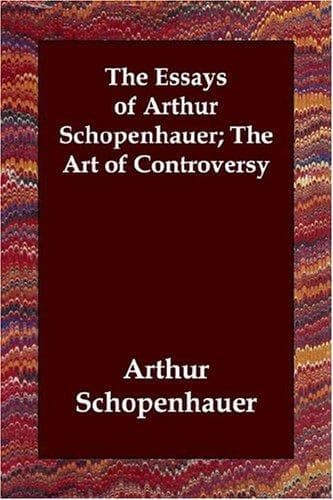
The Essays of Arthur Schopenhauer; the Art of ControversySchopenhauer, Arthur
Philosophy
The Essays of Arthur Schopenhauer; the Art of Controversy
Schopenhauer, Arthur
Debates and debating; Logic
In the productions of poetic genius, especially of the epic and
dramatic kind, there is, apart from Beauty, another quality which is
attractive: I mean Interest.
The beauty of a work of art consists in the fact that it holds up a
clear mirror to certain _ideas_ inherent in the world in general; the
beauty of a work of poetic art in particular is that it renders the
ideas inherent in mankind, and thereby leads it to a knowledge
of these ideas. The means which poetry uses for this end are
the exhibition of significant characters and the invention of
circumstances which will bring about significant situations, giving
occasion to the characters to unfold their peculiarities and show what
is in them; so that by some such representation a clearer and fuller
knowledge of the many-sided idea of humanity may be attained. Beauty,
however, in its general aspect, is the inseparable characteristic
of the idea when it has become known. In other words, everything is
beautiful in which an idea is revealed; for to be beautiful means no
more than clearly to express an idea.
Thus we perceive that beauty is always an affair of _knowledge_, and
that it appeals to _the knowing subject_, and not to _the will_;
nay, it is a fact that the apprehension of beauty on the part of the
subject involves a complete suppression of the will.
On the other hand, we call drama or descriptive poetry interesting
when it represents events and actions of a kind which necessarily
arouse concern or sympathy, like that which we feel in real events
involving our own person. The fate of the person represented in them
is felt in just the same fashion as our own: we await the development
of events with anxiety; we eagerly follow their course; our hearts
quicken when the hero is threatened; our pulse falters as the danger
reaches its acme, and throbs again when he is suddenly rescued. Until
we reach the end of the story we cannot put the book aside; we lie
away far into the night sympathising with our hero's troubles as
though they were our own. Nay, instead of finding pleasure and
recreation in such representations, we should feel all the pain which
real life often inflicts upon us, or at least the kind which pursues
us in our uneasy dreams, if in the act of reading or looking at the
stage we had not the firm ground of reality always beneath our feet.
As it is, in the stress of a too violent feeling, we can find relief
from the illusion of the moment, and then give way to it again at
will. Moreover, we can gain this relief without any such violent
transition as occurs in a dream, when we rid ourselves of its terrors
only by the act of awaking.
Public-domain text, read in full here on John Shaqi.
Reviews
Reviews
No reviews yet
Be the first to share your thoughts on this work.
Join the Discussion
Join the discussion
Sign in to leave a comment or review.
Sign InorCreate an account