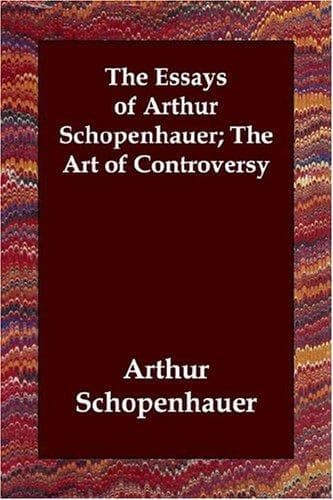
The Essays of Arthur Schopenhauer; the Art of ControversySchopenhauer, Arthur
Philosophy
The Essays of Arthur Schopenhauer; the Art of Controversy
Schopenhauer, Arthur
Debates and debating; Logic
It is obvious that what is affected by poetry of this character is our
_will_, and not merely our intellectual powers pure and simple. The
word _interest_ means, therefore, that which arouses the concern of
the individual will, _quod nostrâ interest_; and here it is that
beauty is clearly distinguished from interest. The one is an affair
of the intellect, and that, too, of the purest and simplest kind. The
other works upon the will. Beauty, then, consists in an apprehension
of ideas; and knowledge of this character is beyond the range of the
principle that nothing happens without a cause. Interest, on the other
hand, has its origin nowhere but in the course of events; that is to
say, in the complexities which are possible only through the action of
this principle in its different forms.
We have now obtained a clear conception of the essential difference
between the beauty and the interest of a work of art. We have
recognised that beauty is the true end of every art, and therefore,
also, of the poetic art. It now remains to raise the question whether
the interest of a work of art is a second end, or a means to the
exhibition of its beauty; or whether the interest of it is produced by
its beauty as an essential concomitant, and comes of itself as soon as
it is beautiful; or whether interest is at any rate compatible with
the main end of art; or, finally, whether it is a hindrance to it.
In the first place, it is to be observed that the interest of a work
of art is confined to works of poetic art. It does not exist in the
case of fine art, or of music or architecture. Nay, with these forms
of art it is not even conceivable, unless, indeed, the interest be of
an entirely personal character, and confined to one or two spectators;
as, for example, where a picture is a portrait of some one whom we
love or hate; the building, my house or my prison; the music, my
wedding dance, or the tune to which I marched to the war. Interest of
this kind is clearly quite foreign to the essence and purpose of art;
it disturbs our judgment in so far as it makes the purely artistic
attitude impossible. It may be, indeed, that to a smaller extent this
is true of all interest.
Now, since the interest of a work of art lies in the fact that we
have the same kind of sympathy with a poetic representation as with
reality, it is obvious that the representation must deceive us for the
moment; and this it can do only by its truth. But truth is an element
in perfect art. A picture, a poem, should be as true as nature itself;
but at the same time it should lay stress on whatever forms the
unique character of its subject by drawing out all its essential
manifestations, and by rejecting everything that is unessential and
accidental. The picture or the poem will thus emphasize its _idea_,
and give us that _ideal truth_ which is superior to nature.
Public-domain text, read in full here on John Shaqi.
Reviews
Reviews
No reviews yet
Be the first to share your thoughts on this work.
Join the Discussion
Join the discussion
Sign in to leave a comment or review.
Sign InorCreate an account