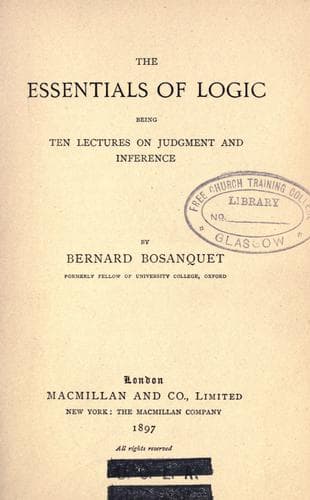
The Essentials of Logic, Being Ten Lectures on Judgment and InferenceBosanquet, Bernard
Philosophy
The Essentials of Logic, Being Ten Lectures on Judgment and Inference
Bosanquet, Bernard
Logic
The major premise belongs only to this figure. In the other it is mere
tradition to call it so, and their two premisses are the same in kind,
and contribute equally to the conclusion, and for that reason the
affirmative conclusion was not general or not formal. If your general
conclusion is to follow by mere form, you must show your principle
as explicitly covering your conclusion. But if you do this, then of
course you are charged with begging the question. And, in a sense,
that is what you mean to do, when you set out to make your argument
complete by its mere form. If you have _bonâ fide_ to construct a
combination of your data, you cannot predict whether the conclusion
will take this form or that form. Using a major premise meant, “We
have got a principle that covers the conclusion, and so explains the
case before us.” Granting that the major premise involves the minor
premise and conclusion, that is just the reason why it is imperative
to express them. The meaning of the Syllogism is that it analyses the
whole actual thought; the fault is to suppose that novelty is the
point of inference. The Syllogism shows you how you must understand
either premise in order that it may cover {150} the conclusion. Or,
starting from the conclusion as a current popular belief, or as an
isolated observation or suggestion by an individual observer (and this
is practically the way in which our science on any subject as a rule
takes its rise), the characteristic process through the three stages
described above consists in first noting the given circumstances under
which, according to the _prima facie_ belief or observation, the
conjunction in question takes place (“yesterday,” _i.e._ “in the state
of the atmosphere yesterday”); secondly in analysing or considering
those given circumstances, to find within them something which looks
like a general property, a law, or causal operation, which may attach
the conjunction in question to the systematic whole of our experience
(the presence of something heavier than air in the atmosphere); and
thirdly, in the exhibition of this ground or reason as a principle, in
the light of which the primary belief or observation (probably a good
deal modified) becomes a part of our systematic intelligible world.
{151}
LECTURE X INDUCTION, DEDUCTION, AND CAUSATION
_Induction_ [1]
Public-domain text, read in full here on John Shaqi.
Reviews
Reviews
No reviews yet
Be the first to share your thoughts on this work.
Elsewhere in the archive
Join the Discussion
Join the discussion
Sign in to leave a comment or review.
Sign InorCreate an account