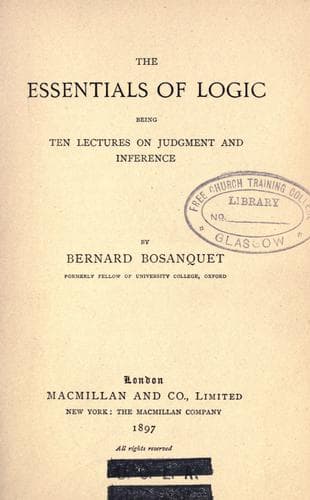
The Essentials of Logic, Being Ten Lectures on Judgment and InferenceBosanquet, Bernard
Philosophy
The Essentials of Logic, Being Ten Lectures on Judgment and Inference
Bosanquet, Bernard
Logic
1. Induction has always meant some process that starts from instances;
the Greek word for it is used by Aristotle both in his own Logic and
in describing the method of Socrates. It meant either “bringing up
instance after instance,” or “carrying the hearer on by instances.” And
still in speaking of Induction we think of some process that consists
in doing something with a number of instances. But we find that this
notion really breaks down, and the contradiction between Mill and other
writers (Jevons, ch. i.) shows exactly how it breaks down. The question
is whether one experiment will establish an inductive truth. We will
review the meanings of the term, and show how they change.
[1] Read N. Lockyer’s _Elements of Astronomy_; Abney’s _Colour
Measurement_; Introduction to _Bain on Induction_; Jevons’s
_Elementary Lessons on “Observation and Experiment”_ p. 228, and
on _Induction_, p. 214 (about Mill).
_Induction by simple Enumeration_
(_a_) Induction by simple enumeration was what Bacon was always
attacking, and saying, quite rightly, that it was not scientific. It is
the method which I stated in the Third Figure of the syllogism, almost
a conversational method; the mere beginning of observation. “I am sure
the influenza is a serious illness; all my friends who have had it have
been dreadfully pulled down.”
{152}
A B C have been seriously ill.
ABC have had influenza.
∴ Influenza is a serious illness.
Now this popular kind of inference, as Bacon says, “Precarie concludit,
et periculo exponitur ab instantia contradictoria.” Suppose you come
across one slight case of influenza, the conclusion is upset. This
type of reasoning really appeals to two quite opposite principles;
one the principle of counting, which leads up to statistics and the
old-fashioned perfect Induction or the theory of chance, the other the
principle of scientific system.
_Enumeration always has a ground_
(_b_) In counting, we do not think of the reason why we count, but
there always is a reason, which is given in the nature of the whole
whose parts we are counting. If I count the members of this audience,
it is because I want to know how many units the whole audience consists
of. I do not ask why each unit is there; counting is different from
scientific analysis; but yet the connection between whole and part is
present in _my reason for counting_. So really, though I only say,
“One, two, three, four, etc.,” each unit demands a judgment, “This is
one member--that makes two members, that makes three members,” etc.
Counting is the construction of a total of units sharing a common
nature; measurement is a form of counting in which the units are also
referred to some other standard besides the whole in question, _e.g._
the standard pound or inch.
_Perfect Induction_
Public-domain text, read in full here on John Shaqi.
Reviews
Reviews
No reviews yet
Be the first to share your thoughts on this work.
Elsewhere in the archive
Join the Discussion
Join the discussion
Sign in to leave a comment or review.
Sign InorCreate an account