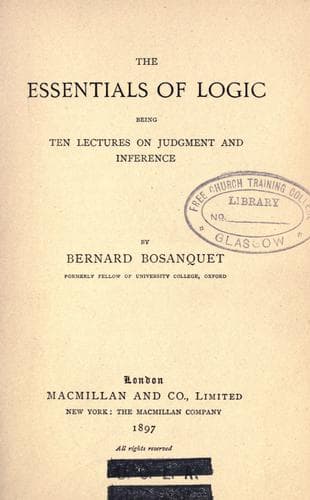
The Essentials of Logic, Being Ten Lectures on Judgment and InferenceBosanquet, Bernard
Philosophy
The Essentials of Logic, Being Ten Lectures on Judgment and Inference
Bosanquet, Bernard
Logic
A universal conclusion in this figure would be formally bad. But we
do not care for that, because we only mean it to be tentative, and we
do not draw a universal affirmative {148} conclusion. We express its
badness by querying it, or by saying “may be.” The reason why it is
formally bad is that nothing general has been said in the premisses
about the middle term or reason, so that it is possible that the two
Subjects do not touch each other within it, _i.e._ that the suggested
special cause, moisture, is not connected with the special effect, the
sinking of the smoke. The general reason “heavier than air” may include
both special suggested cause and special suggested effect without their
touching. Smoke and moisture may both sink in air, but for different
and unconnected reasons. Still, when a special cause is suggested which
is probably present in part, and which would act in the way required
by the general character of the effect, there is a certain probability
that it _is_ the operative cause, subject to further analysis; and
the argument has substantive value, though bad in form. The only good
arguments in this figure have negative conclusions, _e.g._--
Smoke that is heavier than air goes downwards.
Smoke on dry days does not go downwards.
∴ Smoke on dry days is not heavier than air.
This conclusion _is_ formal, because the negative throws the second
Subject altogether outside the Predicate, and so outside the first
Subject. The one content always has a characteristic which can never
attach to the other, and consequently it is clear that some genuine
underlying difference keeps them apart. Such an inference would
corroborate the suggestion previously obtained that the presence of
moisture was the active cause of the descending smoke on days when rain
was coming.
Fig. 1. _A completely reasoned judgment_.
{149}
All particles that sink in the air in damp weather more
than in dry, are loaded with moisture when they sink.
Smoke that descends before rain is an example of particles
that sink in the air in damp weather more than in dry.
∴ Smoke that descends before rain is loaded with moisture
when it descends (and therefore its sinking is not
accidentally a sign of rain, but is really connected with
the cause of rain).
Public-domain text, read in full here on John Shaqi.
Reviews
Reviews
No reviews yet
Be the first to share your thoughts on this work.
Elsewhere in the archive
Join the Discussion
Join the discussion
Sign in to leave a comment or review.
Sign InorCreate an account