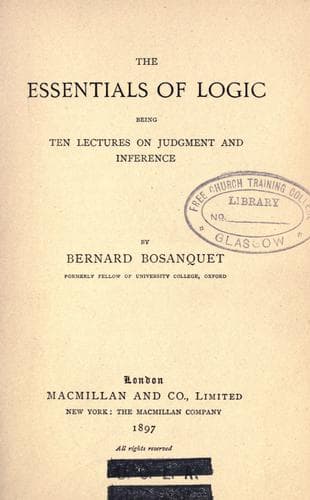
The Essentials of Logic, Being Ten Lectures on Judgment and InferenceBosanquet, Bernard
Philosophy
The Essentials of Logic, Being Ten Lectures on Judgment and Inference
Bosanquet, Bernard
Logic
The moment you begin accurate observation you get a negative with
positive value, which is really the converse by negation of your
positive observation, a1 is b1; b2 (which is _just_ not-b1) is a2
(which is _just_ not-a1). Thus the two may be represented as the same
judgment in positive and negative forms, which confirm one another.
“Yellow is a compound of red and green”--in Experiment, “if, and as far
as you take away the red or the green you destroy the yellow.” That
describes an experiment with the colour-box. I have inverted the order
in the conversions in compliance with the rule of common Logic, that
Predicate is wider than Subject; but in accurate matter it is a false
rule, and very inconvenient. The common rule means that a man who is
drowned is dead, but a man who is dead need not have been drowned; but
of course if he has the signs of death by drowning then he has been
drowned.
_Classification and Generalisation_
(_g_) _Classification_ is a consequence of all systematic theory; it
is not a separate method of science. It is merely the arrangement
of positive contents negatively related. No doubt where we have a
kind of family relations between individuals classification is more
prominent, and in the theory of continuous matter or operation, where
individualities are not remarkable--_e.g._ in geometry--it is less
prominent. But both are always there--classification and theory.
Classification which expresses no theory is worthless, except that
intended for convenient reference, such as alphabetical classification.
Under classification I may say a word on generalisation. {160} The
common idea of inference from many cases, because they are many, to
all cases of the same kind, is quite without justification. The only
genuine and fundamental law of generalisation is “Once true always
true.” But this might fail to suffice for our practical purposes,
because it might save its truth by abstraction. Let us take the
example, “Water is made of oxygen and hydrogen.” If that is true once,
it is always true _in the same sense_. If you find some fluid of a
different composition which you are inclined to call water, then you
must identify or distinguish the two, and this is a mere question of
classification. _Practically_, however, we could not get on unless our
knowledge had some degree of _exhaustiveness_, _i.e._ unless we knew
roughly that most of _what we take for water_ will have the alleged
properties. But no Induction or analysis, however accurate, can assure
us against confusion and error, viz. assure us that everything we take
to be water will be made of oxygen and hydrogen, nor that water will
always be found on the earth. I call this accurate analysis, which
_may_ be made in a single instance only, and is the only perfectly
scientific generalisation, generalisation by mere determination. Its
classification is hypothetical, _i.e._ in it the individuals are merely
possible individuals.
Public-domain text, read in full here on John Shaqi.
Reviews
Reviews
No reviews yet
Be the first to share your thoughts on this work.
Elsewhere in the archive
Join the Discussion
Join the discussion
Sign in to leave a comment or review.
Sign InorCreate an account