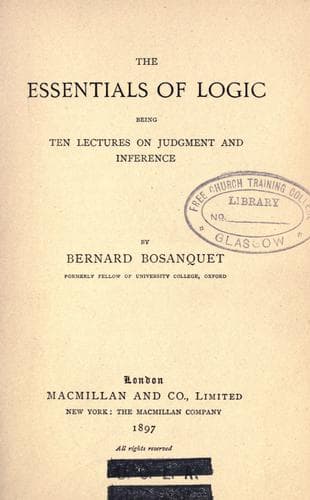
The Essentials of Logic, Being Ten Lectures on Judgment and InferenceBosanquet, Bernard
Philosophy
The Essentials of Logic, Being Ten Lectures on Judgment and Inference
Bosanquet, Bernard
Logic
But this passes into another kind of generalisation, which may be
called generalisation by concrete system, as when we attach scientific
analysis to some extensive individual reality, _e.g._ to the solar
system or the race of man. Then our judgments have a place in the
real world, and our classification is categorical classification. The
generalisation in this case does not follow from the judgment being
extended {161} over a great plurality of possible similar subjects, but
from the subject to which it applies having as an organised totality
a large place in the world; _e.g._ “The human race alone gives moral
interest to the history of bur planet.” These judgments come by making
explicit the reality which underlies such hypothetical judgments as
“all men are capable of morality.” It means that we actually venture to
assign a place in the universe to the system we are speaking of. Then,
though it is an individual, and unique, its name has a meaning, and is
not a mere proper name. The solar system is good instance. Judgments
about it or parts of it are universal but not purely hypothetical,
and as our knowledge of this kind increases it becomes even a little
exhaustive.
_Generalisation by mere likeness or analogy_, on the other hand, is
precarious. It is what popular theory has in its mind in speaking of
Induction, viz. a conclusion from a truth to judgments concerning all
similar cases, _e.g._ from “Water is made of Oxygen and Hydrogen” to
“All liquids which we choose to take for water are made of Oxygen and
Hydrogen.” No scientific method can possibly give us this result. In as
far as it has value it depends upon our guessing rightly by analogy.
It may be replied, “that the signs of recognition are set down in
the law or truth.” Well, if they are certain, generalisation by mere
determination is enough; if they are doubtful, no induction can warrant
your judgment of them in particular cases. Practically, of course, we
get them right pretty often, although wrong very often.
_Hypothesis_
Public-domain text, read in full here on John Shaqi.
Reviews
Reviews
No reviews yet
Be the first to share your thoughts on this work.
Elsewhere in the archive
Join the Discussion
Join the discussion
Sign in to leave a comment or review.
Sign InorCreate an account