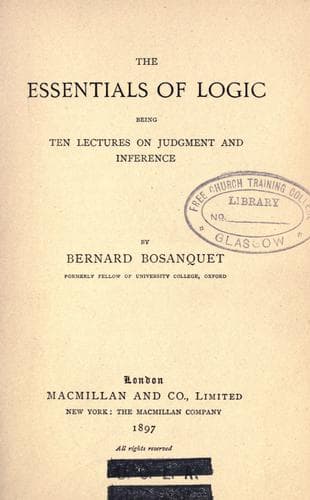
The Essentials of Logic, Being Ten Lectures on Judgment and InferenceBosanquet, Bernard
Philosophy
The Essentials of Logic, Being Ten Lectures on Judgment and Inference
Bosanquet, Bernard
Logic
(_h_) Hypothesis is merely supposition; it consists in suggesting a
fact as if it were real, when it is the only way of {162} completing
given facts into a consistent system. If the hypothesis is proved that
is a demonstration. It has been said that “Facts are only familiar
theories.” If a bell rings in the house, I say unhesitatingly, “Some
one rang that bell.” Once in ten years it may be rung, not by a person,
but by some mechanical accident, in which case the “some one” is a
hypothesis, but one always treats it as a fact. The only proof of a
hypothesis is its being the only one that will fit the facts, _i.e._
make our system of reality relatively self-consistent. We believe many
things we can never verify by perception, _e.g._ the existence of the
centre of the earth, or that you have an idea in your minds; and if we
go to ultimate analysis, perception itself involves hypothesis, and
_a fortiori_ all experiment involves hypothesis. Every experimental
interference with nature involves some supposition as to a possible
connection which it is intended to confirm or disprove.
_Deduction_
2. Classification and hypothesis bring us into Deduction, which is not
really a separate kind of inference from Induction, but is a name given
to science when it becomes systematic, so that it goes from the whole
to the parts, and not from the parts to the whole. In Induction you are
finding out the system piecemeal, in Deduction you already have the
clue; but the system, and the system only, is the ground of inference
in both. Induction is tentative because we do not know the system
completely. Their relation may be fairly represented by the relation
of the first figure of the Syllogism to the second and third. The
difference is merely that in deduction we are sure of having knowledge
which covers the whole system. If a man observed, “The difference
{163} between the dark blood in the veins and the bright blood in the
arteries calls for explanation,” that is the beginning of Induction. If
a man states the circulation of the blood as an explanation, that is
Deduction. Really Induction is only a popular name for such Inference
as deals with numbers of instances. Mill’s experimental methods do
not depend upon number of instances, but only upon content; they
presuppose the instances already broken up into conditions A, B, C, and
consequents a, b, c.
I must distinguish subsumption and construction as two forms of
deduction. Only the former _properly_ employs Syllogism in the first
figure.
_Subsumption_
Public-domain text, read in full here on John Shaqi.
Reviews
Reviews
No reviews yet
Be the first to share your thoughts on this work.
Elsewhere in the archive
Join the Discussion
Join the discussion
Sign in to leave a comment or review.
Sign InorCreate an account