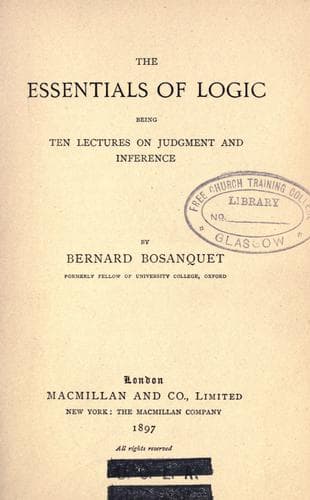
The Essentials of Logic, Being Ten Lectures on Judgment and InferenceBosanquet, Bernard
Philosophy
The Essentials of Logic, Being Ten Lectures on Judgment and Inference
Bosanquet, Bernard
Logic
All of us are familiar with the appearance of a microscope ready
adjusted for use, with its little lamp, its mirror and illuminating
apparatus under the stage, with a specimen on the stage under the
object-glass, its object-glass and its eye-piece. Any one who
understands the working of a microscope finds this a most suggestive
spectacle. He follows in his imagination the light as it comes from
the lamp to the mirror, through the illuminating lenses, through the
transparent specimen, through perhaps a dozen lenses arranged as an
object-glass within an inch of distance, through the eye-piece and
into the observer’s eye. Give him the parts, lenses, prisms, and
mirrors into his hands, and he will test them all, and tell you exactly
how they work. This {16} scientific onlooker may be compared to the
psychologist looking at another man’s mind. He sees it as a thing among
other things, a working system of parts.
But there is one thing that the mere onlooker cannot see. He cannot
see the object. That can only be seen by looking through the tube.
And every one has felt, I should think, the magical transformation,
suggestive of looking through another man’s eye and mind, which occurs
when you put your eye to the eye-piece of an optical instrument. The
outside world of other objects, the tube, the stage, the mirror, the
bystanders, the external light, all disappear, and you see nothing but
the field of vision and whatever distinctly pictured structure may
be displayed within it. The observer who looks through the tube may
be compared with each one of us as he contemplates his own world of
knowledge and perception. This is a thing that no one else can ever do.
The metaphor, indeed, breaks down, in so far as each of us is able to
observe the history and character of his own mind as an object within
the field of presentation which is before his mind. Of course such a
metaphor must break down at some point. But it remains true that the
mind, while directly observing its field of objects, cannot observe its
own peculiarities, and when turned, as we say, upon itself, is still
observing only a part of itself. It remains true that my mind contains
the whole presented world for me and is merely one among thousands of
similar mind-things for you.
Public-domain text, read in full here on John Shaqi.
Reviews
Reviews
No reviews yet
Be the first to share your thoughts on this work.
Join the Discussion
Join the discussion
Sign in to leave a comment or review.
Sign InorCreate an account