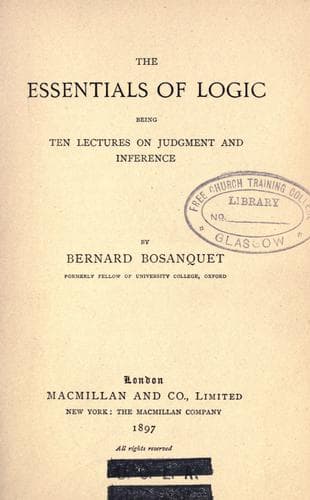
The Essentials of Logic, Being Ten Lectures on Judgment and InferenceBosanquet, Bernard
Philosophy
The Essentials of Logic, Being Ten Lectures on Judgment and Inference
Bosanquet, Bernard
Logic
Thus, I repeat, the world for each of us is our course of
consciousness, looked at in that way in which it presents a {17}
systematic, organised picture of inter-acting objects, not in that way
in which it is a stream of ideas and feelings, taking place in our
several heads. In the former point of view it is the world as our idea;
in the latter point of view it is simply the consciousness attached to
our body. We might soon puzzle ourselves with the contradictions which
arise if we fail to distinguish these points of view. In one sense my
mind is in my head, in the other sense my head is in my mind. In the
one sense I am in space, in the other sense space is in me. Just so,
however rough the metaphor, from one point of view the microscope is
one among a host of things seen from the outside; from the other point
of view all that we see is in the microscope, which is itself not seen
at all.
It is in this latter sense that our mental equipment is looked at, when
it is regarded as knowledge; and it is in this sense that it forms a
panorama which absolutely shuts in every one of us into his own circle
of ideas. (It is not implied, we should carefully observe, that his
ideas or experience are in any way secondary to his self, or separable
from it, or an adjective of it.) Then how does it happen that our
separate worlds, the panoramas which we construct, do not contradict
one another?
The answer is, that they _correspond_. It is this conception from
which we must start in Logic. We must learn to regard our separate
worlds of knowledge; as something constructed by definite processes,
and corresponding to each other in consequence of the common nature
of these processes. We know that we begin apart. We begin in fact,
though not conscious of our limits, with feelings and fancies and
unorganised experiences which give us little or no {18} common ground
and power of co-operation with other people. But as the constructive
process advances, the correspondence between our worlds is widened
and deepened, and the greater proportion of what we are obliged to
think is in harmony with what other people are obliged to think. Now
of course this would not be so unless reality, the whole actual system
in which we find ourselves, were self-consistent. But more than that,
it would not be so unless the nature of intelligence were the same in
every mind. It is this common nature of intelligence, together with its
differentiated adaptations to reality, that we have to deal with in
Logic.
Public-domain text, read in full here on John Shaqi.
Reviews
Reviews
No reviews yet
Be the first to share your thoughts on this work.
Join the Discussion
Join the discussion
Sign in to leave a comment or review.
Sign InorCreate an account