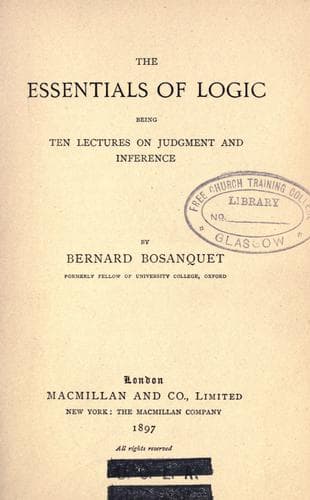
The Essentials of Logic, Being Ten Lectures on Judgment and Inference — John Shaqi
The Essentials of Logic, Being Ten Lectures on Judgment and InferenceBosanquet, Bernard
Philosophy
The Essentials of Logic, Being Ten Lectures on Judgment and Inference
Bosanquet, Bernard
Logic
[1] Our estimate of Berkeley’s view must depend on the degree
in which we judge him to have identified the Deity with, or
separated Him from, a permanent and universal system. The
statement in the text applies fairly to Hume.
_The world as_ Knowledge
2. Therefore we say, coming closer to our subject, that “_Knowledge_
is the medium in which our world, _as an interrelated whole_, [1]
exists for us.” This is more than saying that it exists in mind or
presentation, because the mere course of consciousness need not
amount to Knowledge. A world, that is, a system of things acting
on one another, could not exist merely in the course of our ideas.
But _Knowledge_, we said, is the mental construction of reality. It
consists of what we are obliged to assert in thought, and because we
are all obliged to think assertorily according to the same methods,
the results of our thinking form corresponding systems--systems that
correspond alike to each other and to reality. (I may be asked, does
not this agreement of {23} our knowledge depend on the agreement of
the physical stimuli supplied to us by nature, as well as on the
homogeneousness of our intelligences? The answer is, that these
stimuli, or nature, have no priority in Knowledge. Their identity is
merely a case or consequence of the identity of our experience as a
whole. We are regarding nature as a system developed in experience, not
as an unknown somewhat behind it. To suppose that solid or extended
existence somehow comes before and accounts for everything else, is a
form of the common-sense theory we have dismissed. Knowledge and Truth
have their limitations as forms of Reality, but an appeal to solidity
or extension will not furnish the required supplementation.)
[1] The words italicised make a reservation in favour of
feeling, which has its own form of reality, but is not
relational.
_Knowledge is in the form of Judgement_
3. All that we have been saying about Knowledge is summed up in the
sentence, “Knowledge is a judgment, an affirmation.” We need not
trouble ourselves yet about negation. We all know what affirmative
assertion is, and it is near enough for the present to say that all
knowledge is judgment in the sense of affirmative assertion.
I will explain how we sum up all we have said of knowledge by calling
it a judgment.
Judgment or affirmation always implies three properties, though they
are not always recognised.
It is (a) necessary, (b) universal, and (c) constructive.
_Judgment necessary_
Public-domain text, read in full here on John Shaqi.
Reviews
Reviews
No reviews yet
Be the first to share your thoughts on this work.
Join the Discussion
Join the discussion
Sign in to leave a comment or review.
Sign InorCreate an account