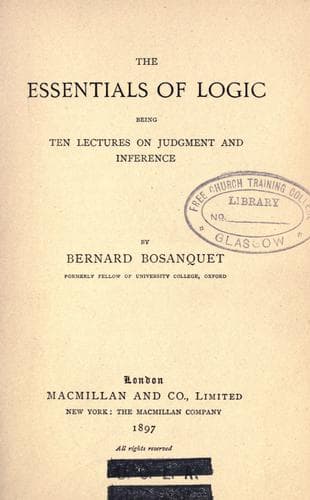
The Essentials of Logic, Being Ten Lectures on Judgment and InferenceBosanquet, Bernard
Philosophy
The Essentials of Logic, Being Ten Lectures on Judgment and Inference
Bosanquet, Bernard
Logic
Subjective Idealism necessarily arises if the common-sense theory of
two worlds, the real outside the mind, and the ideal, copying it,
within the mind, is pushed to its conclusion. The real, outside the
mind, being inaccessible, falls away. The arguments of this Idealism,
as Hume said, “admit of no answer and produce no conviction.” [1]
But I {20} mention the idea, because I do not think that any one
can really understand the problem of Logic, or indeed of science in
general, without having thoroughly thought himself into the difficulty
of Subjective Idealism. It is necessary to be wholly dissatisfied with
common-sense theory, and with the notion of a ready-made world set up
for us to copy in the mind, before the logical analysis of intellectual
construction can have interest or meaning for us. And to produce this
dissatisfaction is the value of Subjective Idealism.
[1] Vol. iv. p. 176 (ed. of 1854), _Inquiry concerning Human
Understanding_, sect. 12.
{21}
LECTURE II “JUDGMENT” AS THE CONSCIOUSNESS OF A WORLD
_Defect of Subjective Idealism_
1. The last lecture was devoted to explaining the distinction between
the stream of presentations and the world as it is for knowledge.
I ended by calling attention to the theory known as “Subjective
Idealism.” This, I said, has the merit of forcing upon us the question,
“How do we get from mind to reality? How do we get from subjective to
objective?” For we have always to remember that our knowledge _is_
within consciousness, though it may _refer_ outside it.
On the other hand, Subjective Idealism has the _defect_ of confounding
the very distinction which we took so much trouble to make plain. Its
essence lies in ascribing to the world of knowledge properties which
are only true of the stream of presentation. It is quite true that the
actual presentations of this room, which each of us has in his head
at this moment, are all different from each other, and different from
any which we have had before, and shall ever have again. Every minute,
every second, they differ; they are perishing existences, wholly
mental, and each of them when past is irrecoverably gone. That is the
property of a presentation within the course of consciousness. It is a
particular perishing existence.
{22} But Subjective Idealism says, “Because these mental existences are
particular perishing existences, and all knowledge consists in them as
its medium, therefore the object of knowledge is nothing beyond these
mental facts, and is not rooted in a permanent system [1] independent
of our mental connections.” Here we must check the inference, and
reply, “No, it does not follow. The presentations which themselves come
and go may refer to something in common, and through them all we may
become aware of something that is not wholly in any of them.” In other
words, there is in Knowledge no passage _from_ subjective to objective,
but only a development of the objective.
Public-domain text, read in full here on John Shaqi.
Reviews
Reviews
No reviews yet
Be the first to share your thoughts on this work.
Join the Discussion
Join the discussion
Sign in to leave a comment or review.
Sign InorCreate an account